
Spring Issue
April 16 2026
Thoughts About C and E Day
by izzy mundel’25

On January sixth, just as students came back from a long winter vacation, the St. Marks community gathered together for Community and Equity Day. A day, as the name suggests, to foster better relationships and a more inclusive environment at SM. Huddling together in the PFAC, we first listened to a panel discussion by five inspiring individuals who all strive to create more inclusivity and equity within their own communities. Each of the individuals' own individuality helped them provide St. Marks with advice that was unique to different environments and situations. Their individual positionalities allowed the community to make connections with their own lives, but also to empathize with and learn about people that may be different or have different experiences from their own. After this insightful conversation, we then split up, the student body into their respective sports teams, while the faculty stayed together, for a hands-on workshop with a purpose: to speak freely about our identities and what makes us different inside the St. Mark’s community. Being vulnerable is something that within the hustle-and-bustle environment at SM we don’t get to do a lot. It’s hard to speak openly about your own individuality and uniqueness when surrounded by a classroom full of people that you may not know individually or trust with that information. However, this is what made C and E day so thoughtful. The workshop opened up a space to be open and vulnerable with people you saw every day at athletic practices, that you hopefully do know and trust. It allowed for a comfortable discussion between people about their unique identifiers, and how that informs who they are at St. Marks.
In general, I believe the day was a success. The panel offered interesting perspectives and advice about fostering a supportive and inclusive environment, and the workshop created a much-needed space to be vulnerable with our peers. That isn’t to say that St. Marks don’t have more work to do, it does. One day a year where the community comes together and each person shares their identity isn’t enough to create an inclusive and supportive environment all year long. It takes daily work, from the students, to the faculty, to the staff, in classrooms, in dorms, in the hallways, in the dining hall, to create an environment where people feel heard, respected, and belonged.
Opinions on Flik: New Flik Setup
by Jasmine Liu’25

Photo: Karen B. Bento featuring the St. Mark’s School dining hall
The end of the long winter break marked the beginning of numerous changes such as the new year, mid-year exams, and, unexpectedly, a new FLIK dining setup.
Last year, the FLIKand dining hall setup largely stayed consistent. When you first walked to the FLIK kitchen, you would be greeted by the tall stacks of plates right outside the entrance to the servery. There would be a long sequence of main dishes, typically replicated to accommodate two lines for the influx of hungry teens. The left would feature a small table of dessert and breakfast options for students with gluten-free diets. The servery would feature the meal’s main dishes as well as vegetarian alternatives if applicable. At breakfast, the last section would have oatmeal with a variety of sweet toppings including chocolate chips, M&M's, and coconut sprinkles. Lunch and dinner would have pasta and sauce options in this area, accompanied by a stack of bowls. After choosing from the main options, students would proceed to the next area with the bread (different bagels and bread slices), cereals, drinks (soda, water, coffee, milk), and one or two dessert options. When students got to the dining hall, they would be able to also add options from the salad bar (or the fruit and yogurt bar at breakfast). During lunch, the soup section in the main dining area and the panini bar in the small dining hall would also be available for students to choose from.
Yet, with feedback from faculty and students, the new year brought about many changes in the FLIK setup. First, FLIK added a noodle bar to the main dining hall where students could make their own noodle dishes. The bar would have pre-boiled noodles (typically soba or lo mein) in a separate container to prevent the available noodles from getting soggy in the soup. There would be a separate section for soup, with miso soup and chicken broth being the usual options. Students can add as many toppings of green onions and tofu as they would like to the noodle dish. Chopsticks and spoons would lay next to the noodles and soup selections. Second, FLIK increased the variety of desserts available. In the past, desserts would revolve around pudding, rice krispies, dessert bars, and cookies. However, students have now been able to eat cupcakes, cheesecakes, eclairs, and other treats thanks to FLIK! Third, FLIK added a new section of snacks between the water and coffee machines, with snacks featuring goldfish, pistachios, and granola. Students could grab a plastic or paper cup nearby and simply fill the cups with these snacks to take on the go in the case of post-meal hunger.
Last and most prominently, FLIK drastically changed the setup of their previous services. First, the staff moved the gluten-free options for the main options and desserts to the room adjacent to the servery. The breads and bagels also got rearranged in fancier drawers and setups. The water machines were moved to accommodate the added snacks, while the desserts were moved to the main dining hall. The salad and soup bars also shifted around; the soups moved to the small dining hall to accommodate the location of the new noodle bar.
With these drastic changes in the FLIK setup, some students expressed their surprise. “It’s taken a while to get used to for sure,” Sam Mundel’25 remarked. Fortunately, though, many students have noted improvements in FLIK dining and dessert options. “The food is really good now!” Diana Oh’24 exclaimed, “The desserts are amazing and the quality improved for sure!” Other students also affirmed that the desserts became more “innovative” and hoped that the quality of the treats would be consistent for the rest of the year. The tiramisu, cupcakes, and cheesecakes were common favorites among students. In fact, many students, including Vivi Tran’26, wished for tiramisu to make more frequent appearances in the dining hall.
Students also appreciated the new noodle bar. “I really like having more dining options, especially the noodle bar.” One Fifth Form student asserted, “If I don’t like the main options for a specific day, I can always enjoy a nice bowl of noodle soup. While the noodles may not be the same as a dish you find at a ramen restaurant, the noodle bar still does the trick!” Another Third Form student added, “However, I wish [the dining hall] could have soy sauce…” Other students provided critique and feedback about the noodle bar. For instance, a Sixth Form student remarked that the noodles “can be a bit dry” but understood that it would be “inevitable.” Some students also wished for more variety in the available soups and noodles. “Personally, I want to have some vermicelli or udon noodles,” Crystal Hui’24 said.
The dining hall’s added snacks also got its fair share of compliments and criticisms. “I like the snacks,” Eli Zahavi’24 noted, “The goldfish is good, but I hope they can switch it up too.” Other students, such as Yejee Hwang’25, enjoyed the bagged snacks that FLIK provided sometimes during seated meals.
Faculty also seemed to enjoy the dining hall improvements after the new year. Although faculty acknowledged the improved quality of seated meal dishes and options, some faculty still preferred to cook at home if possible: “FLIK is a good option for having a nice and convenient meal, but I try to cook at home for dinners when I don’t like what’s on the menu.”
Overall, both students and faculty have indicated that the changed setup of the FLIK dining hall was a step in the right direction and a sign of future improvements. Yet, members of the St. Mark’s community still point out some areas for further improvement. With the added Google Form in the Weekend Activity slides & QR Codes on the dining hall tables, students can directly give FLIK feedback on meals and suggest meal ideas for the future! While FLIK’s food may not always appeal to everyone’s tastes, we should all appreciate the amazing work that the FLIK staff has done daily to serve the hundreds of people in our St. Mark’s community, and we continually look forward to the improvements FLIK may offer in the future!
A Reflection on Rev. Talcott's Talk
by Laura Xia’25

During evening chapel on January 30th, Rev Talcott delivered a well-loved speech on types of relationships. The speech is based on the ideas of philosopher Martin Buber, who characterizes relationships into two broad categories: “I-thou” relationships and “I-it” relationships. In simple terms, an “I-thou” relationship is when one treats the other as a fellow human being worthy of respect whereas an “I-it” relationship is when one treats the other as a tool or means to a goal. Rev Talcott provided examples of these two types of relationships and encouraged us to reflect on and categorize our own relationships, changing or discarding the “I-it” ones and nurturing the “I-thou” ones.
Both Rev Talcott’s talk and Buber’s book I and Thou characterize “I-it” relationships as hurtful relationships. Though I agree with this idea, I find an “imbalance” relationship more hurtful than an “I-it” relationship. Buber categorizes relationships into “I-it” and “I-thou” ones because he focuses on the perspective of one person in the relationship. However, if we think of the relationship from the point of view of both parties, we come to find three types of relationships:
“I-thou” + “I-thou”
“I-it” + “I-it”
“I-thou” + “I-it”
The first and second types are not hurtful, although admittedly the first type is superior in that it is more long-lasting and worthy of maintaining. I think of the first type as a “friend” relationship, in which both persons value each other for what they are as a whole. We accept each other entirely, and we don’t “need” anything from each other except reciprocated love and acceptance. Since in such relationships we value each other for who we are as a being, no one can be hurt. On the other hand, the second type is a “lab partner” relationship. We engage with our lab partners for their positive qualities, whether it be a strong work ethic or good communication skills. Instead of viewing the other person as a whole being, we oftentimes simply see them as an “efficient work partner” who serves as the means for us to get a good lab grade. Although it involves “I-it” approaches, no one is hurt in a “lab partner” relationship. This is because the involved parties are both well aware that their relationship is an “I-it” one. No one expects their lab partner to care for them as a fellow person, we just want them to get the job done. So it is impossible to be hurt in a “lab partner” relationship because the scales are balanced—we equally don’t care enough about each other.
The third type of relationship, characterized by an "I-thou" relationship combined with an “I-it” one, is the hurtful one. Here, one individual has genuine care and regard for the entirety of the other, while the recipient views them solely through the lens of utility, valuing only a specific trait that is useful to them. This imbalance becomes painfully apparent when one realizes they are degraded to a mere tool in the eyes of their counterpart, rid of recognition for their intrinsic humanity. It’s like realizing that a beloved friend thinks of you as only a great lab partner who helps them get an ‘A’ in their projects.
The most hurtful part of these unbalanced relationships is the fragility of them. Should the "I-thou" individual no longer embody the trait or quality viewed as valuable by their "I-it" counterpart, the delicate equilibrium breaks, and the relationship fades as the “I-it” individual stops needing the “I-thou” individual.
How do we stop ourselves from being harmed by an unbalanced relationship? To balance the scale, we either force more care into the “I-it” individual or take away care from the “I-thou” individual. Although both of these courses of action are hard, the latter is relatively more achievable. As an “I-it” individual in a relationship, it is hard to care more about the other person because the incentive to care more stems from wishing the other person well. If they never cared, there is no way to force more care into them. On the other hand, it is possible to strip away care from the “I-thou” individual even if the process is painful. The essence is to gradually decrease expectations for the other person and face the fact that they cannot reciprocate the care.
Ultimately, the trick to not being hurt in a relationship is recognizing the importance of balancing the scale. And for more meaningful relationships, try to focus on the “I-thou” relationships where the other person is willing to reciprocate.
Declining Attendance: Reassessing the Purpose of Chapel
by Lucas Jiang ‘26

Chapel is the oldest and most frequent all-school community event at St. Mark’s. However, in a mere three weeks, the dean of students office sent two all-school emails addressing the low attendance rates at morning chapel. What lies behind the dwindling participation of the longest-lasting tradition at St. Mark’s?
In an interview, Reverend Talcott observed that attendance had “always been a problem since the pandemic. Attendance at everything has been difficult,” she said, “I would say chapel attendance got worse with the pandemic and it’s hard to bring it back to where it used to be.” Reverend Talcott has been a religion teacher and chaplain for fifteen years at St. Mark’s. Since the beginning of the year, the school has taken measures to improve attendance, including merging academic and non-academic absences
“At the beginning of the year, we tried to bring people from remote chapel into the actual Chapel. They didn’t fit. Now we definitely can bring them back, but what if students decide to come back? I guess we’ll just fail and try again next year.”
Sleep vs. Chapel
Reverend Talcott reasons that students choose not to come to Chapel because they choose to value sleep over Chapel. “I don’t think it’s an irrational decision, but I do agree with the dean’s office that Chapel is a critical part of the St. Mark’s experience,” she comments.
Indeed, morning Chapel starts at 8 AM on Tuesdays and Fridays and most students have expressed that it can be difficult to wake up. Especially during cold winter mornings, leaving the bed and attending Chapel poses a daunting task to all. Many students have reported missing Chapel because of oversleeping or staying up the night before. As Howie Shi ‘26 recalls: “I just missed Chapel yesterday because I overslept, but that was the only time this year.”
Lack of interest
Yet when asked, “Would you attend Chapel more if it was moved to a later part of the day,” the majority of students answered no. In a survey asking students to rate Chapel on a scale of one to ten, an average of 7.1 was recorded with the lowest being 4.5 and the highest being 9. Interviewees who gave lower-than-average ratings answered that they did not see the purpose of Chapel. On the other hand, interviewees who gave higher than average ratings said that Chapel, especially the three minutes of silence, prepared them for the day ahead.
When asked about the purpose of Chapel, Reverend Talcott mentioned Chapel talks. “We think your Chapel talk is your gift to the community; your graduation gift to the community that has raised you for three or four years… It really is that same thing: the bearing of culture, from the older to the younger students.” Currently, the waiting list for Chapel talk sign-up has exceeded records in past years. However, despite the eagerness of sixth formers to give Chapel talks, not everyone finds them meaningful. “Sometimes it gets repetitive,” says an anonymous fifth former. Certain themes can become monotonous when mentioned repeatedly, especially to those who have been at this school for years. Nonetheless, many interviewees marked Chapel talks as their favorite or second favorite part of Chapel.
Religion
St. Mark’s is a religious center of an Episcopal school that has a widely diverse student body. As such, it is difficult to balance the needs of different groups. Rebecca Garland ‘25, a Presbyterian, hopes that “there could be a tiny bit more of scriptures and whatnot.” On the other hand, Sherry Mi ‘26 thinks the current Chapel is a great balance of secular and religious elements.
Of the twenty minutes in Chapel, around half of the time is for Chapel talks about personal experiences, five minutes for hymns, two minutes for prayers and readings, and three minutes for silence. Apart from traditional Christian music and prayers, Chapel also includes Buddhist, Hindi, Muslim, and Jewish texts to include all students and faculty. Reverend Talcott notes, “Chapel is here to serve you guys. I need to know who you are to craft a Chapel that is going to lift you spiritually. A pastor like me or Reverend Solter always has to be paying attention. Of course, you’re diverse so I can’t meet all of your needs all the time.” Perhaps another reason for the low attendance is that Chapel cannot meet everyone’s spiritual needs.
Conclusion
In summary, the declining attendance at St. Mark's morning Chapel reflects the allure of sleep, the disinterest in Chapel talks, and varying perceptions of religion. Despite efforts to address these issues, the fundamental question remains: what makes Chapel meaningful for each member of the community? Moving forward, dialogue and adaptation are needed to ensure that the longest-lasting tradition at St. Mark’s can cater to the changing and diverse needs of the community.
The Spectrum of 'I-Thou' and. 'I-It' Relationships
by Rachel Ding’26
After Evening Chapel on January 30th, Rev. Talcott’s sermon on the intersection between love and relationships inspired introspection into and appreciation for the relationships in our homes and at St. Mark’s. According to twentieth-century philosopher Martin Buber, our approach to any relationship—platonic, familial, or romantic—can be characterized as either “I-Thou” or “I-It.” In the preceding relationship, an individual can recognize the inherent value of the other as a whole being. Both members experience a mutual sense of connection, respect, and engagement. Conversely, an "I-It" relationship involves a more instrumental and transactional approach. An individual treats the other as an object, where one perceives the other as something to be used, manipulated, or controlled for personal gain. There's a sense of detachment and objectification, thereby leading to a superficial connection.
At a glance, the main takeaway from the sermon seems to encourage “I-Thou” relationships and discourage “I-It” relationships. However, I encourage you to develop your own opinions before taking this as the complete truth. Ask yourself the following questions—I have included some situations that disprove what is widely accepted to sort of play devil's advocate.
Are there situations where approaching a relationship with a more transactional mindset (I-It) could be beneficial or pragmatic?
a. In group projects or task-oriented collaboration, adopting an "I-It" approach with the understanding that the relationship focuses on completing tasks rather than deep personal connections might boost efficiency in achieving a common objective.
How do "I-It" relationships foster mutual benefit, where both parties may derive satisfaction from the exchange?
a. In "I-It" relationships, clear expectations and boundaries are oftentimes established from the outset. Both parties understand their roles and responsibilities within the interaction, leading to more efficiency in achieving desired outcomes. By focusing on the transactional aspects of the interaction, both parties can maximize their time and resources, leading to a more productive exchange.
Can the exclusivity and intensity of "I-Thou" relationships inadvertently lead to feelings of isolation from other social connections?
a. "I-Thou" relationships often require significant time, energy, and emotional investment. As individuals become deeply involved with one another, they may prioritize the needs of the other person above other social connections. Furthermore, these relationships are more exclusive, as individuals form deep connections with only a few people. While this exclusivity can strengthen the bond between individuals within the relationship, it may also inadvertently cause them to neglect or distance themselves from those not part of the inner circle.
Can the depth and intensity of an "I-Thou" relationship cause emotional dependency? How do these dynamics affect your sense of autonomy within the relationship?
a. In an "I-Thou" relationship, emotional dependency can develop when individuals rely heavily on their partner/friend to meet their emotional needs and provide a sense of security and validation. This reliance may lead to a diminished sense of self as individuals prioritize the other person's needs and interests over their own.
b. Emotional dependency can also contribute to a loss of individual identity within the relationship. Individuals may become so immersed in their connection that they struggle to differentiate their thoughts and feelings from those of the other person. This blurring of boundaries can weaken their sense of autonomy and independence. Emotional dependency often coexists with a fear of separation or abandonment. Individuals may go to great lengths to avoid disagreement, fearing it will jeopardize their connection and lead to rejection.
At the end of the day, relationships aren't black and white. The significance of human connections lies in their complexity and diversity. While "I-Thou" relationships promote genuine connection, "I-It" relationships can serve practical purposes. We can take insight from philosophers like Martin Buber, but ultimately, how we interpret and apply these beliefs lie in our hands—our experiences shape how we navigate these relationships. By embracing the nuances of each relationship and seeing it through different perspectives, we foster interactions that transcend categorizations.
The First Gray Colloquium - Was it Different?
Anouk Shin ‘26
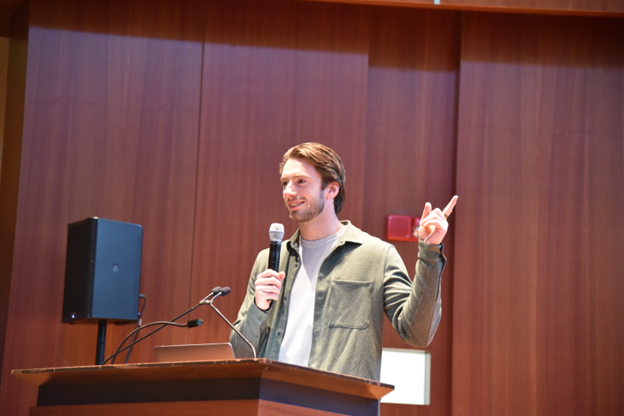
Gray Colloquium has been a distinctly St. Mark’s event for many years, each year bringing a new topic for speakers to discuss. This year’s first was Dino Ambrosi, a digital wellness speaker, who stood behind the microphone and gave a distinct presentation that captured the engagement of many students.
Ambrosi’s talk was on the harms of technology on lives. Although it was a topic high school students have been lectured on many times, from Ambrosi, it felt different. “He was more of an engaging speaker,” says Erin Rasmussen ‘23, “especially compared to the speakers we had before.” Other students agreed that Ambrosi’s speech was helpful and outstanding compared to past speakers, and attributed this memorableness to his experience working with high school students.
In particular, the diagram Ambrosi presented during his speech, depicting the remaining weeks in a lifetime and how many of those weeks would be spent on social media, seemed to have left a striking impression on many students. Rasmussen ‘23 continues, “My favorite part of the talk was the dots on the screen that showed how much of our lives were going to be spent on our phones. I think that really puts it into perspective.” Howie Shi ‘26 adds that he was “very surprised” by what the diagram showed, and Yolanda Zhou ‘23 states that it prompted her to be “more aware of [her] screentime.”
Although informative and engaging, the largest part of Dino Ambrosi’s speech was the impact it had on the St. Mark’s community. Many students downloaded Clear Space, the app Ambrosi recommended in his presentation, and found it effective: “I downloaded the app that [Ambrosi] talked about, Clear Space. I use it on my Instagram, and my Instagram usage went down, like, a lot. I barely even use it anymore. I don’t scroll either,” says Seoyeon Kim ‘26. Zhou speaks of a similar experience, stating, “I’ve downloaded [Clear Space] and I’ve been using it. It’s been pretty helpful.”
Furthermore, the impact of Ambrosi’s speech went beyond students. The voluntary “No Cellphone Wednesday” was inspired by his speech, and was implemented almost immediately after the talk. It encouraged St. Markers to experience a school day with no screen time.
Dino Ambrosi set the Gray Colloquium series off to a great start this year. The messages of his talk and the positive impacts he made on St. Mark’s will resonate with many students, reminding us to not have the remaining weeks of our lives snatched away by mindless scrolling.
Opinions on Integrated Science
Andrea Xu ‘25
In the past two years, the most significant change to St. Mark’s academics in the past two years is Integrated Science. In the fall of 2022, the science department implemented this curriculum change. Instead of following the “freshman physics and sophomore chemistry” track, all incoming freshmen take two years of Integrated Science before taking any Advanced courses in their upper-form years.
Mr. Palmer, the science department head, proudly lists two reasons he initiated the Integrated Science curriculum: “Every student leaves an understanding of important science issues, and prepare students for higher-level science regardless of the discipline they pursue, not just to cover a whole bunch of content. That’s why I think it’s better.”
Ms. Glenn, who taught Integrated Science last year, debriefs her experience teaching the course, “It is mostly difficult to teach, especially when teachers are not experts in all fields of science. But since it’s an introductory-level course, it was alright.” Like Mr. Palmer, Ms. Glenn likes how Integrated Science helps students understand that science is not a vacuum. The course fosters the idea that different disciplines are not independent; instead, we cannot learn one without the other. For example, teaching Advanced Physics: Electricity and Magnetism this year, Ms. Glenn finds chemistry necessary to understand the concepts in physics.
Admittedly, the curriculum is “constantly changing.” The science faculty met over the summer to reflect on their new ways of teaching. For instance, the final project for one of the units last year was to write a letter to the local officials about a water issue. However, this year, students will do an infographic for the water unit. Improvements come over time when teachers observe how receptive students are to the materials.
Pursuing her master's in biomechanics, Ms. Glenn felt comfortable answering students’ deeper questions about biology and physics. Yet, when students probed into the mysteries of chemistry, she shrugged, saying, “I’ll let them ask Mr. Buchholz, who is the chemistry teacher.”
In our conversation, I also broached a sensitive topic of discussion: grading. Ms. Glenn is not afraid to admit that students hated the grading,, which was a point of anxiety for them. In St. Mark’s, many classes use standard-based grading, including Integrated Science, biology, and others. However, as the teacher, Ms. Glenn likes the standard-based grading system because it diverts the students' focus on learning the basic skills, especially in lower grades. Further, standard-based grading shows progress over time. Students make mistakes in the beginning, but over time, they will improve throughout the windows and show mastery later in the year.
Do students concur with the teachers’ sentiments?
A returning sophomore, Sherry Mi ’26, shares her opinion about Integrated Science. She says, “It helps me to find a way to study science that suits me the best.” Sherry also enjoys the broad gamut of subjects Integrated Science covers and project-based learning. “Projects were effective in summing up the contents I studied in class, ” she adds.
Ada Chen, ’27 is a new freshman. Overall, Ada thinks science at St. Mark’s is fun, but she elaborates that some content in Integrated Science overlaps with what she learned in her previous school. For example, “right now, we’re learning how to draw ionic bondings. I already know how to do it but we’re asked to draw it in a different way, which is off-putting.”
This is the second year of running Integrated Science. The student bodies have varied stances on this new curriculum. Teachers are adjusting to this new teaching system. There is a lot to unpack. With the testimony of time and trials, we hope to see more positive feedback on Integrated Science and leave students with the critical skills to learn science anywhere in the world.
Cracking the Dress Code
by anouk shin

The St. Mark’s handbook has contained a lengthy description of the dress code for years, a paragraph new students are shocked by as they prepare for school as a freshman. Many change their wardrobe completely, buying new clothes to adhere to the extensive rules, while others avoid such lengths and simply hope they aren’t “dress-coded” in the hallway. Either way, St. Mark’s’ ‘only-bookstore-hoodies-business-casual’ dress code has been a long controversial topic in the community, between both students and teachers. And now, with a new school year and debate on school dress among faculty, it’s time to find out what new (and old) St. Markers really think about dress code.
There seem to be two common points about the dress code students feel the need to change: the prohibition of blue jeans and non-St. Mark’s hoodies.
“It’s not too bad, but there are things I think aren’t necessary, like the blue jeans,” says Vivi Tran ‘26, “I also understand that we’re not allowed to wear graphic T-shirts, but I don’t understand why we can’t wear non-St. Mark’s hoodies and sweatshirts.”
Kat Garland ‘27 carries the same sentiment, “I would change sweatshirts. As long as the sweatshirts aren’t too ‘unprofessional’ I think it’s fine. I mean, I see people wearing regular sweatshirts already.”
“I would like there to be blue jeans, I don’t see a problem with it,” adds Meigs Dorsheimer ‘27. The students around her mutter in agreement, commenting on the fact that, while ripped jeans could be considered inappropriate, prohibiting regular blue jeans is a rule hard to accept.
However, blue jeans go much deeper than a preferred fashion choice among students. According to Lori Cui ‘25, not allowing blue jeans is even inherently classist: “The working-class typically wore blue jeans throughout history,” she says, “and there are working-class families at St. Mark’s.” The strict rule on blue jeans may give the impression that families in the working class are not welcomed or seen as equal to upper-middle and middle classes in St. Mark’s.
But blue jeans aside, St. Markers seem to be very aware of why the dress code needs to be in place, even if they disagree with certain aspects of the guidelines.
“We can’t just show up to school wearing something too inappropriate or casual. This is a nice school, and we should be ready for the school day,” Paige Mattson ‘27 states. Judy Xu ‘26 similarly notes that a dress code should be in place to prevent unprofessional attire. Lori Cui ‘25 acknowledges that “dressing for a setting makes you more inclined to behave properly in that setting.”
The dress code is a tradition St. Mark’s has endorsed for decades. However, with time comes new students, new understandings, and a questioning of traditions. St. Mark’s is in the middle of this questioning period, where the community comes together to find a middle ground. And hopefully, through amendments and discussion, we will finally be able to crack the dress code.
What's been working? What needs work?
by Anouk Shin ‘26

It’s no secret that St. Mark’s prioritizes anti-racism—and understandably so. As a small and “very diverse school, bettering yourself to be anti-racist and more inclusive of the people around you is more important”, says Elizabeth Pellini ‘23.
From Pathways groups to C&E day, our school’s devotion to inclusivity and multiculturalism is apparent in student life, academics, and all school events. But what do St. Markers think? Which aspects of St. Mark’s anti-racist efforts actually uplift anti-racism among students within our community—and which head in the opposite direction?
Fortunately, many of the current efforts towards anti-racism seem to be working their magic. Steven Zhang 24’, says that “Affinity groups and C&E day “reduce preconceptions and prejudice [of racial identity] in the school”, and as the St. Mark’s faculty board becomes more diverse each year, Joel Lawore 25’is “happy that St. Mark’s is definitely taking more of an initiative on [recruiting faculty of color].” For Joel, a diverse group of faculty is a “crucial” effort towards anti-racism in the long term: “Students are here for four years, but it’s the faculty that stay that really make the community what it is.”
St. Mark’s mission to combat racism makes an impact in the classroom as well, namely by “incorporating inclusivity into [its] courses,” according to an anonymous third former. One example of this “inclusivity”, she says, is apparent in The Global Seminar: “Its core values [are] learning cross-cultural dialogue and how to be respectful with people’s differences.”
However, despite the successful anti-racist efforts St. Mark has made over the years in school events, faculty, and the classroom, there is still room for improvement, according to St. Markers.
One issue, Steven notes, is the occasional “over-the-top” nature of school-wide events relating to anti-racism. To Steven, an important aspect of promoting anti-racism is not only the means of promotion, but also the student response—and “pressur[ing] students to [attend events] that they really don’t want to” may make it even “more unlikely that [students] will actually start becoming more anti-racist.” According to Steven, one example of an “over-the-top” event was the Lion Dance, mostly due to the fact that “[St. Mark’s] made [the event] mandatory for the whole school”. In addition to the event being mandatory, he says, many students “weren’t happy with the time that [the Lion Dance] was placed in” and “not many people were necessarily as interested.”
Events related to the anti-racist effort that are disliked by students can pose serious problems. In these events, intended messages of multiculturalism and anti-racism may go overlooked, and in the worst-case scenario, a negative perception of a culture or anti-racism may be instilled. So “in the future,” Steven suggests, “we can have these types of events, but we shouldn’t put them in such a weird time and force them to be mandatory.”
Joel believes that there are “a lot of things” relating to anti-racism and inclusivity St. Mark’s could improve upon. “Not to be pessimistic”, he adds, “just [thinking] with that growth mindset.”
Something that has been “very hard to deal with” but seems “prevalent” for Joel at St. Mark’s are the struggles students with a minority background face while adapting to the community: “When you are a student that comes from a very different background, it’s very tough to acclimate,” he says, especially because there are many students from “similar backgrounds.” Immediately jumping to a potential way to address this complex problem, Joel adds that just “being aware, whether you’re a teacher or student” and having “more Affinity Group involvement would definitely help” in mitigating the issue.
Implementing complete anti-racism in any institution is a noble, but very difficult task to accomplish. Nonetheless, I am glad to see that St. Mark’s is constantly committed to the seemingly impossible goal of anti-racism, and I hope, through feedback, changes, and everything in between, we continue to run closer to that finish line for generations to come.