
"What do we eat?" : Problems at the Panini Station
by Katie Park ‘21
When I am dismissed from class around 12:20, I rush down the stairs to get in line for lunch. However, on days when I do not have much luck, I get there a little late and the line starting from the Main Dining Hall has already passed the Small Dining Hall. In this case, I swiftly run to the Small Dining Hall and grab a panini. Since I am more of a person who would rather have a panini than wait in line, I grabbed paninis for about one-third of my lunches last year. Also, I liked having a panini for lunch because there were various fillings that I could put on it.
This year, however, I am having a slightly different experience with the panini bar.
The Small Dining Hall went through renovations over the summer that changed the arrangement. The panini press is no longer on the side that leads to the Hinkle Room. Last year, it was harder for people to sit on the table right in front of the panini press due to the line that stretched to the table. In order to fix this problem, FLIK decided to place the panini press right next to the panini bar, which gives more space for the people in line and for people to sit at the table right in front of Hinkle Room. However, there are downsides to the new position of the panini bar. There are not as many meat and cheese options as last year. One day during lunch, there was only lettuce, tomatoes, egg salad, and only two types of cold cuts (ham and cheese). I could still make a panini out of these options, but it was definitely more limited than last year, when there was ham, turkey, and chicken for the meat options and at least two different types of cheese.
The Main Dining Hall also went through some changes. There used to be two salad bars, but Flik got rid of the second one and replaced it with a smaller toppings bar. This definitely provided more room in the Main Dining Hall. However, since the dressings are only in the first salad bar, as opposed to last year when there were dressings on both, some people had to go back to the first salad bar after getting the toppings from the next bar. Furthermore, a new suggestion is that since there is more room than last year, it would be better if the first salad bar and the toppings bar are pushed more toward the Small Dining Hall since the line waiting for the salad bar and the line to bus plates often clash.
We appreciate all the effort Flik puts into changing the setup of the dining hall. However, it always takes trial and error to reach excellence, and this process is no different.
Traditional to Technical: More Classes incorporate Online Learning
by Luke Lee ‘20
Recently, I have noticed an interesting trend among courses at St. Mark’s: teachers are offering more paper materials and course content online. Sure, there are times where I solve questions on paper, but those occasions are very few. In the past, I would only use my computer while writing my English or History paper. For subjects like math, science, and language, I had to do almost all of my work on paper. But now, I need my computer for all of my classes. Instead of giving out worksheets or problems on the textbook, my math teacher posts a link on Canvas that directs me to the homework. For chemistry, students conduct labs online instead of actual labs using the Atomsmith Classroom, a computer simulation program. And instead of writing down our responses on the lab sheet, we submit our responses on a website called GoFormative. Sometimes, I question if carrying a backpack to school is necessary; it seems these days all I need is my computer.
There are definitely advantages to having more materials online. For one, students don’t have to carry giant textbooks to school everyday. Online materials are not only beneficial to the students, but also to Mother Earth. By working online, both students and faculty use paper much less. This reflects St. Mark’s sustainability statement, which ensures that the school “actively fosters environmental stewardship.” Why bother printing worksheets and handing it to students? Teachers can tell their students to check on Canvas.
Online tools are usually easy to use, but that is not always the case. Often, these programs don’t work. Take, for example, my Advanced Statistics and Chemistry class. During our statistics class, Mr. Lester asked us to install R Studio, an open source data analysis software. It took almost the entire 45 minute block for us to install the software because some of us weren’t able to download it. Yet, the features of the software are also available on our calculator, and the software has only been used for two classes. During our chemistry class, we had to download the Atomsmith Classroom for computer simulations of gas molecules. However, two students weren’t able to install the program on their own, so they wasted a lot of class time trying to make it work. The next day, Dr. Smith-Nichols instructed us to record our responses on GoFormative. But unfortunately, most students weren’t able to do their work in class because the website was down. Few students had their pages open from last night, so they were able to submit the response.
A few weeks into the beginning of the year, I was curious if students’ opinion of online resources have changed so I sent out a survey to my statistics class to see what their thoughts were on the online tools. According to the survey, 80% of the class were fine with the online materials, while 20% of them preferred offline materials. And when my classmates were asked how comfortable they were with R Studio and online homework on a scale of 1 to 5, most students gave 3’s or 4’s, which shows that they are pretty comfortable with the online materials. Although online resources are generally accepted by students, there are still rooms for improvements.
Transition Time: Reflections on Being a New St. Marker
by Cathy Zhou ‘21
It is never easy to transition into a new environment. St. Mark’s is a place as welcoming and supporting as it could be, there are definitely surprises as well as discomforts for new students. For third formers, high school could be a novel but stressful experience and as for new students coming as upperformers, a new school could be hard to fit in.
Gift Wichayamas, new IV Former
Q: How do you feel as a new senior?
A: Everything is new and a rush. I feel like I am a freshman most of the time except
when they call sixth former and faculty to leave first. There are so many things to learn: the American culture, the college application process, names to remember, and of course, my English is to be improved. The fact that everyone already knows each other for at least two years make me feel awkward joining a conversation sometimes.
Q: What's your favorite thing about St. Mark's?
A: I have two favorite things here so far. My first one is the schedule here. In Thailand,
I had eight blocks every weekday from 8 a.m. to 4 p.m, so having 6 classes and a free block at St. Mark’s is way better. However, the homework load here still hits me hard. Also, I love how supportive people are here at St. Mark’s. When people say “hi” or smile back at me, it lights up my day.
Q: What are you looking forward to in the school year?
A: I am looking forward to meeting new people, trying to speak up more, and getting into college. I also want to go watch games and join more activities. Generally, I want to do anything
that would make my first and last year here memorable!
Skylar Davis, new V Former
Q: How do you feel as a new junior?
A: Being a new fifth former is honestly a lot easier than I thought it would be. I was kind of worried, since two years of high school have already passed and there are only two year left, but everyone is really nice and inviting!
Q: What's your favorite thing about St. Mark's?
A: I really love the general environment, but especially the community. It is a very tight-knit community and I like the communal aspect rather than a more traditional school setting.
Q: What's your favorite dining hall food so far?
A: I love the sprinkle cookies! They're not sugary to the point of overpowering, but the sprinkles add the best touch.
Q: What are you looking forward to in the school year?
A: I'm really excited for neon, especially since people kept talking about it (haha), and Groton night!
Q: How do you feel about the orientation?
A: Orientation was absolutely exhausting, but it was also really great for a lot of reasons. I got lost so often during orientation that I've barely gotten lost during the school year! (I wish I was joking...) I also got to meet a lot of really cool people during orientation, outside of the stress of the classroom.
Lina Zhang, new IV Former
Several days ago, an old friend asked me how life was at my new school. Looking at her question, I had to pause and think for a bit. As a new sophomore, one of the first things that hit me as I walked in was the sheer size of the school. Driving up to the front circle, the expanse of the football and soccer fields had me wide-eyed and nervous. Walking through the buildings by the side of a student leader, I remember thinking that I would never find my way anywhere. Standing in line with my parents, I saw my peers for the first time. Some were calm, smiling easily as they received their orientation packets, striking up conversation with the person next to them; others glanced around with wary eyes, as scared as I was at the time. But with these two weeks, the initial fear and awe I held for St. Mark’s has transformed into something of fond annoyance. True, speed-walking from the dining hall to third floor STEM in five minutes is challenging, I still stop and ask for directions to the PFAC (until realising it was an entire building), and the location of the dorms in the Main Building remains a mystery.
I told her, life’s good, still hanging on; the people here are crazy—crazy nice, yes, but also plain crazy. From the blindfolding activity outside Ms. McBride’s window, to the random outbursts of songs in my Spanish class, life in general is always hectic and filled with surprise. Not usually a social person, I am continuously astonished by the amount of friends that I have made here, and how different they can be, while still being kind and truthful. I do not boast to know every single quirk of St. Mark’s, or to even have any idea of what midterm and final weeks must be like, but the campus is no longer overbearing or spacious. I look to the coming year with excitement.
Arden Williams, new III Former
Q: How do you feel about the orientation?
A: Orientation was very long.
Q: What's your favorite thing about St. Mark's?
A: Being a boarding student!
Michael Fisher, new III Former
Q: What's your favorite dining hall food so far?
A: The sandwiches.
Q: How do you feel as a new student?
A: I feel anxious as a new student.
Day of Silence
by Jenny Tang ’20
When I go to school, I step out of Boston’s Logan Airport. When I go back home, I land at the San Francisco International Airport.
Splitting my time near two of the most liberal cities in two of the most liberal states, one can say that I live a sheltered life: I have confronted overt homophobia neither in my school or home community. I have a voice. And when the immediate environment is so accepting, it is easy to forget that the reality can be otherwise.
But reality can be otherwise. It is otherwise in countless parts of the world, numerous states in this country, and even right under my nose. Individuals there do not have a voice. 74 countries outlaw homosexual activities; 30 states allow employment discrimination based on sexuality and gender identity. These are merely the legalities. Many more people see being LGBTQ+ as a spreading sickness to be cured.
My impression of acceptance by my entire local community was eventually shattered. Some parents in my old middle school have a group chat which my mom joined. One day last year, she sent me an excerpt of their chat history—a parent was appalled by how the school’s sex-ed teachers told the students that being LGBTQ+ is normal. This comment was joined later by many others who affirmed that the school is converting their children into mentally-illed. One parent came to LGBTQ+’s defense, but after the opposition drowned her reply in insults, she never commented again.
Silence.
Though I still believe that rejection is in the minority in my local community, this event disillusioned me. It reminded me that, sometimes, the world is otherwise. Individuals there do not have a voice.
I guess that’s what the Day of Silence means to me. Our silence throughout the day resonated with the silence of the LGBTQ+ community in countless parts of the world and reminded us of the work yet to be done. Trapped in a liberal bubble like St. Mark’s where one can take the acceptance for granted, we do need reminders like this.
Voices. But sometimes, silence is so much louder.
The Importance of Discourse
by Matt Walsh ’19

Forgive me for the cliché, but at St. Mark’s, we live in quite the bubble.
Throughout most of its history, St. Mark’s has been a haven for the privileged, moneyed elite. Despite the school’s noble effort to diversify and its increasing commitment to promoting equity and inclusion, St. Mark’s will remain a bastion of privilege. It’s an unavoidable reality for most boarding schools.
The school’s high concentration of privilege has given us a blanket under which we can hide from the issues that plague the real world. Moreover, St. Mark’s, and almost every boarding school, suffers from an extremely short memory—a memory short enough to cause students to forget about an event like the Las Vegas shooting within a couple of days.
Political discourse exists at St. Mark’s—I have found many opportunities to talk politics with a wide range of people—but this discourse often occurs within the context of the school community. While the conflict in Israel, for example, may occupy students’ minds for a few days, nothing incites student discourse more than political events within the school. Community and Equity Day, for example, yielded far more political discussions than did the airstrike Donald Trump sent to Syria in April. In the same way, the walkout on Friday, April 20 fomented far more discourse about gun violence than any mass shooting that occurred in the school year did.
In an era where information is so easily accessible, there is no excuse to remain oblivious. Ordinary citizens now have the ability to help cure social ills and inequities. Some would argue that ordinary citizens have the ability and therefore the obligation to help solve the problems of the 21st century. Endowed with privileges and awareness of the social ills that grip our world, St. Markers can help too. And civil discourse remains the cornerstone to solving the world’s problems—after all, the Civil Rights Movement only succeeded because Martin Luther King and other nonviolent demonstrators inspired conversation in northern cities.
The walkout served a variety of purposes. First, we wanted to honor the seventeen lives that were lost in Parkland. Furthermore, we wanted to promote civil discourse and legitimize student demonstrations. Throughout history, older generations have viewed student protests as illegitimate, naive and misguided, and the nasty ad hominem attacks against the Parkland students served as evidence. Thus, we wanted to embolden students to become more involved in political demonstrations and understand that their calls for change are legitimate. In this spirit, we printed voter pre-registration forms and provided the students the opportunity to pre-register to vote.
Gun violence is a uniquely American epidemic. No other country in the developed world has such a high gun homicide rate. Communicating that gun violence, objectively, is an issue in the United States was the first step in advertising the walkout. Moreover, we stressed that the walkout lacked a political agenda. The goal of the walkout was to encourage student civil disobedience, and Rwick and I understood that giving the walkout a political bent would deter many students from participating.
The moderated discussion, however, allowed for students to voice specific solutions to the gun violence epidemic. While some proposed stricter background checks and bans on particular weapons, others called for the use of armed guards to defend schools and other public places against shooters.

Gun violence is not an issue that directly affects St. Mark’s School. While specific students may have particular experiences with gun violence—and many shared these experiences during the walkout—the threat of a shooting does not loom over St. Mark’s. Thus, discussions directly after the Parkland shooting, while not nonexistent, were somewhat sparse. But by making gun violence a relevant topic within the school community, the walkout encouraged more political discourse. The success of the walkout demonstrates that the best way to get students involved in political causes is to make the cause relevant to them.
February Political Cartoon
by Cecily Bradley '19

“Eric, How are we going to relate more to the liberal teens of this great country?”

“Check mate”
SM Discipline Process Explained
by Justin Zhang '19
The St. Mark’s disciplinary process is rarely discussed amongst the student body. Students are reminded of the Student Discipline Committee and its disciplinary responses announced in school meetings. Nevertheless, many discipline violations do not result in the typical SDC that students are familiar with. This article aims to provide a comprehensive overview of the discipline process, including different levels of offenses and discipline responses to those offenses.
At St. Mark’s, school rules are established under core values of community living: respect, safety and honesty. Students and parents are required to sign a document confirming their understanding of community policies before the beginning of each school year. Many school rules surround these three tenets of community living.
Breaches of school rules are separated into three levels in terms of the severity and nature of those offenses. A violation of minor school rules including “casual lying, disobedience of faculty instructions, use of tobacco products, gambling for money, unauthorized use of heat-producing appliances (Coffee makers, rice cookers, water kettle, etc.), and unauthorized possession of prescription medicine” is considered a Level III offense and makes a student liable for Dean’s Warning. Dean’s Warning serves as a notification for students that another violation of minor school rules might lead to sitting before the SDC. It is important to note that, as stated by the Student Handbook, a second Level III offense violation by a student within one academic year is considered a Level II offense, in other words, a violation of major school rules. “Deliberate lying of a single offense, knowingly being in presence of marijuana, drug paraphernalia or alcohol, tampering with school property, being off campus without permission, unauthorized visitation, unauthorized use of vehicles, and academic dishonesty” are all violations of major school rules and are considered Level II offenses. A student who has a Level II offense is most likely to be placed on Dean’s Final Warning, meaning that a subsequent offense of major school rules to occur while the student is placed on Dean’s Final Warning will automatically result in an SDC hearing. However, students with Level II offenses may also be brought before the SDC as all Level II offenses leave students liable for suspension. A Level I offense is the most severe breach of major school rules and will make the responsible student liable for dismissal. Level I offenses include blatantly rude behavior toward other members of the community, vandalism, possession of firearms, bullying in any form, possession or knowingly being in presence of illegal drugs, distribution of drugs or alcohol, and repeated academic dishonesty. According to the Student Handbook, “a second violation of a Level I or Level II at any time during a student’s St. Mark’s career” and “any Level II offense compounded by lying about that offense.” are all considered a Level I offense.
Students who violate major school rules (Level I and II offenses) will almost certainly be brought before the SDC. However, the decision on whether to hold a SDC hearing is made by the Dean of Students, or the Dean of Academics, and the Head of School by first determining the nature of the violation. Once a SDC is deemed appropriate, both the responsible student and the faculty member that reported the violation will write statements to the SDC concerning the event. During the SDC meeting, the committee will hear an account from the responsible student, a statement made by the student’s advisor on behalf of the student and from a peer character witness who also speaks on the student’s behalf. The entire process is completely confidential and only open to those present in the meeting. The SDC then examines the situation and recommends an appropriate response to the Head of School. Each SDC member is allowed to have individual opinions on the penalty, however, the Head of School will make the final decision. Students who are suspended will be sent home for four academic days. Students who are dismissed will have to leave campus as soon as possible and not allowed back on campus without specific permission from the School.
In terms of the disciplinary process’ influence on the college application process, the College Counselling Office must notify colleges on expulsion or withdrawal of a student in their sixth form year, as well as any suspension during their St. Mark’s career. If a student is suspended after college applications are submitted, that student is required to write a letter to colleges informing them of the disciplinary infraction. In short, expulsion and suspension are the only disciplinary responses that are reported to colleges.
It is important to keep in mind that there are resources available for students to avoid such disciplinary responses in the face of school rule violations, such as FASTeam and sanctuary. FASTeam is a tool for those who are concerned about other students in the community to prevent that student from getting into any disciplinary trouble while also providing that student with the appropriate help they need through counseling. Sanctuary, on the other hand, applies when a student’s health is at risk while using drugs or alcohol on campus. “Students brought to Health Services under Sanctuary conditions will not come before the Student Discipline Committee, they will be held accountable for their behavior through meetings with the School Counselor.”
Community and Equity Day 2018: “Is this homophobic?”
by Lora Xie '20
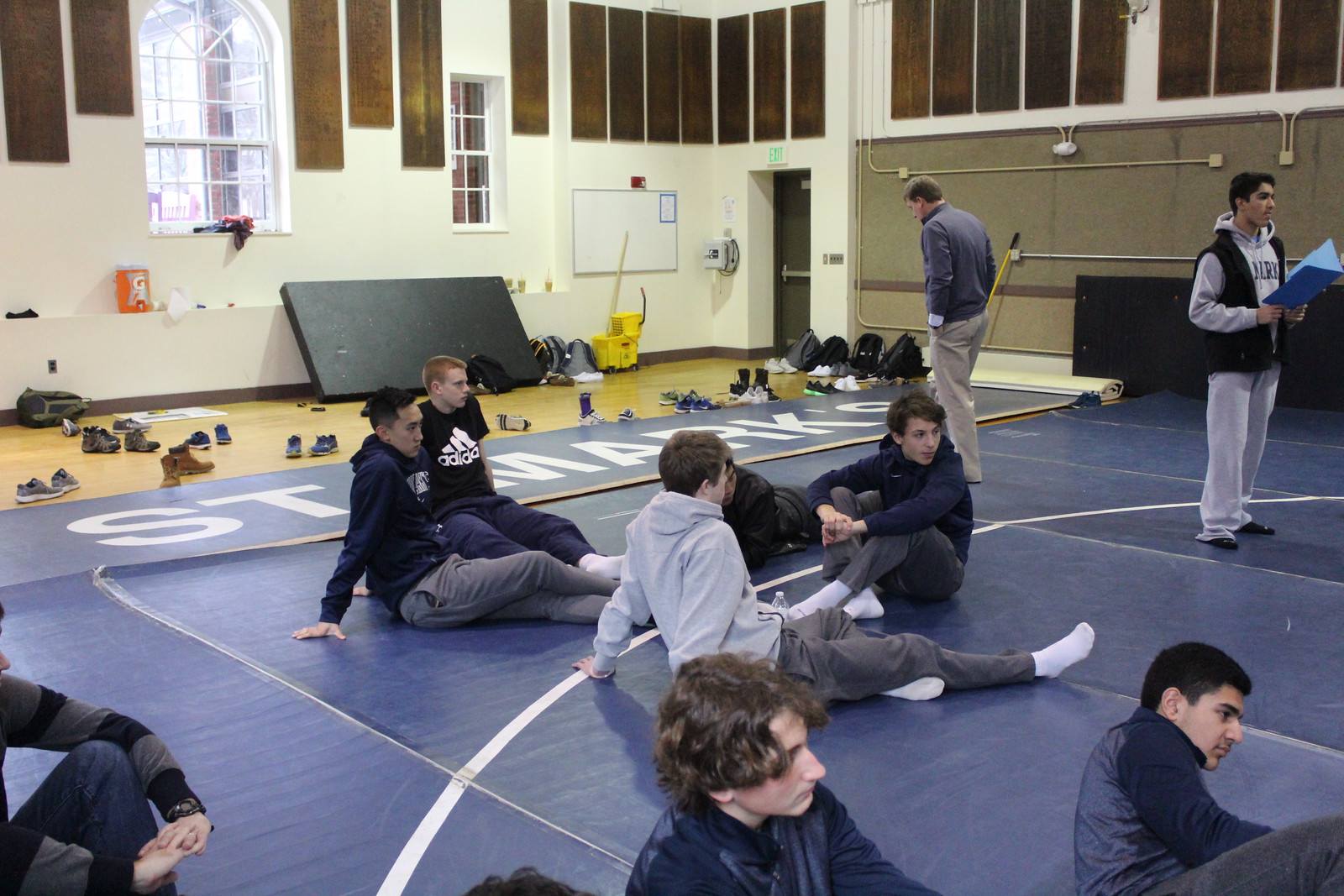


“You overheard two people talking in the locker room about how accurate their ‘gaydar' is. Is this homophobic?" the student leader asked. Small groups began discussing among themselves. When the time came for them to share their respective conclusions - red card for “definitely problematic,” yellow for “borderline problematic,” and green for “not problematic” - different groups showed everything from green to red to a combination of two colors that signals somewhere in between. My group raised a green card without hesitation. Looking around me, I was surprised at the great diversity of opinions. How could anyone regard this situation homophobic? Isn’t that a little over-sensitive? Confusion rose in my heart. Fortunately, the all-group discussion that followed shed light on our divergence. First of all, it turned out that we had different definitions of homophobia. While the groups that gave out green passes defined homophobia as dislike or fear of homosexual people, other groups that showed yellow and red cards included prejudices against homosexual people as a qualifier for homophobia. In this regard, we agreed that the concept of “gaydar” was largely, if not completely, based on stereotypes. Another discrepancy was derived from our different understanding of the scenario. The groups that showed red card pointed out that the two individuals were essentially outing people by boasting about their “gaydar,” thus being disrespectful and potentially harmful. The other groups, however, did not deem privacy as an issue because they reasoned that the two could only talk about the “accuracy” of their speculation if it was confirmed - – if the subject of discussion had come out him/herself. Whether this conversation is rude and/or malicious depends on where the “evidence” for the sexuality of the subjects come from - they themselves, eyewitnesses, or rumors. These pieces of information were not provided to us. In the end, after getting some definitions and conditions on the same page, it turned out that we held strikingly similar core beliefs: respect and equality are desirable, and stereotypes and discrimination are toxic.
At first glance of the varying colors of our cards, we seemed so different from and contradictory to one another! Without the discussions that followed, we could have easily dismissed those with different opinions as nonsensical or morally corrupt, when in fact our divergence stemmed from reasonably different understanding of the terminology and the scenario.
This activity, like many others on the C&E Day, reflects real-life situations. We seldom have all the information we need to make a comprehensive, definitive judgment. We are all blind men groping about a giant elephant called life, which is far too complex for any individual human mind to apprehend. The different images we have acquired from our limited experience are further blurred by the inherent ambiguity of natural languages in communication. Because of the limit of human experience and communication, it is critical that we refrain from putting labels on people and actively seek understanding. Before accusing and condemning one another, we should ask “what do you mean by that?” and “why do you think so?” Maybe we will be surprised by how fundamentally similar we all are deep inside.