
Gray Colloquium
by Abby Stone‘26 and Catherine Zhang‘26
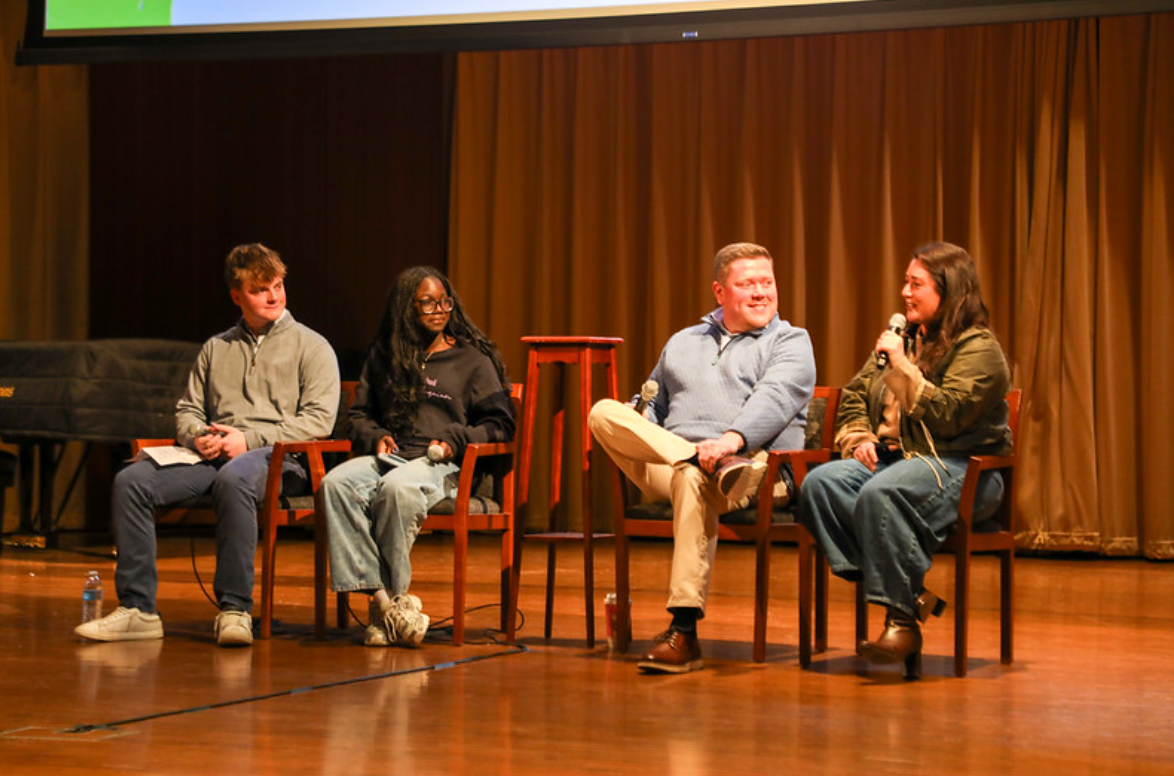
Most people watch sports for the scoreboard. Lyndsey Armacost ’14 and Ryan Sullivan watch for everything else. When the two media professionals visited St. Mark’s for January’s Gray Colloquium, their panel focused on journalism and its impact on the college network, the sports industry, and social injustices.
Armacost said that instinct began at St. Mark’s, where she wrote for the St. Marker and eventually created her own sports blog. Those early experiments taught her that reporting was less about sounding polished and more about chasing the questions that mattered.
“I had a passion for finding answers,” she said. “There is a difference between writing well and learning to write in your own voice.”
Sullivan’s path looked nothing like hers. He entered college planning on business, shifted to marketing, and only stumbled into media through early work in operations and equipment management. His first full time role at the Big Ten Network was in communications, where he learned how to write with clarity and purpose.
“That role taught me how to write concisely and professionally,” he said. “It has helped me in every job since.”
Despite their different beginnings, both now work in roles that require them to translate the human side of sports into stories audiences can feel. Armacost discovered video storytelling at Northwestern and realized how much power lived in pacing, sound, and emotion. At ESPN she produces long form investigative pieces that often involve people at their most vulnerable. She recalled being sent to Uvalde after the 2022 school shooting and meeting families who had lost children.
“You cannot go in with a script for conversations like that,” she said. “You listen. You build trust. No two situations are the same.”
Sullivan works on the opposite end of the spectrum, overseeing digital content across Big Ten schools. His team films everything from sensitive personal features to lighthearted moments like golfing with Caitlin Clark or mic’d up practices. Much of the work focuses on Olympic sports that rarely receive national attention, which he sees as an opportunity rather than a limitation.
“We want to amplify athletes who do not always get the spotlight,” he said. “Sometimes that means a sensitive story about loss. Sometimes it is golfing with Caitlin Clark. Sometimes it is a mic’d up practice. It is all storytelling.”
Both emphasized that sports never exist in isolation. Armacost spoke about sportswashing and the importance of questioning narratives that feel too simple or too convenient.
“If you see a headline you do not understand, read about it,” she said. “Ask why. Give everything a Google.”
Sullivan reminded students that collegiate athletes, despite the spotlight, are still young adults balancing school, training, and public scrutiny.
“They look like pros on TV, but they are still learning and still growing,” he said. “Our job is to support them and tell their stories responsibly.”
When asked what advice they would give to students interested in media, both pointed to the value of practice and discomfort. Armacost encouraged experimentation.
“Try things,” she said. “Write badly, write better, build something, fail, figure it out.”
Sullivan urged students to develop communication skills and push themselves socially, noting that he was a quiet high schooler who never imagined speaking publicly.
“You grow by getting reps,” he said. “Written communication, verbal communication, putting yourself out there. It all matters.”
Overall, St. Mark’s was grateful to have both Armacost and Sullivan share their experiences with the community. Their visit offered students a clear look at how thoughtful, responsible sports storytelling is built, and the school was fortunate to learn from two professionals who continue to shape the field with care and intention.
