
Prize Day Issue
May 15 2026
How I Crammed My Winter Break With Psychos
BY COCO CHEN ‘24
The past break has been truly a pleasure for those of us who finally get to do what we have always wanted to do. For me, the best thing would be to hold my laptop and read or watch something from dusk to dawn, on my bed of course. And as I reviewed my book and movie list today, it is quite intriguing to me that my favorite ones are all psychopathic — no judgment here, please. Just sit back and read.
Who’s Afraid of Virginia Woolf? by Edward Albee

Short, witty, and vulgar at times, Who’s Afraid of Virginia Woolf? is a fascinating play that captures the subtleties and complexities of married life as a metaphor for the Cold War (it is very hard for Albee to not get political). The play revolves around Martha and George, a middle-aged couple who develops a toxic co-dependent relationship with each other by hurling verbal abuses and sometimes physical aggression. As guests of the house, Nick and Honey involuntarily join this domestic farce as they watch how the couple damages each other while they start to realize how broken apart their own marriage has become. The play explores several themes including toxic masculinity, marriage, gender roles, communication failure, and most importantly, the irony of reality and illusions. As we read the play, not only are we abhorred or even disgusted by the ugly behaviors the couples manifest to each other, but we also start to question ourselves whether such moments have been recurrent in our lives and whether we, too, are afraid of Virginia Woolf, a life without illusions or self-delusion. Albee is a genius in his diction, organization, themes, and of course, wordplay. The drama film in 1966 directed by Mike Nichols, featuring Elizabeth Taylor as Martha and Richard Burton as George, is a great realization of the play.
A Clockwork Orange by Anthony Burgess

Yes, the infamous Alex DeLarge may remind us of many canonical characters like Shakespeare’s Iago and Edmund, Milton’s Satan, and Goethe’s Faust. As we follow the Nadsat language of this aberrant yet charismatic young man whose life is centered around sex, violence, and Beethoven, we get into his mind and experience what it is like to be a criminal. When the government imposes Ludovico’s Technique on him, basically injecting him with medicine to make him paralyzed and susceptible when he watches horror film footage from like Nazi genocide, we somehow feel sympathetic towards this juvenile delinquent who has become a victim himself of governmental manipulation. We see some 1984 or Mengele extremities behind this, but really, it is close to our world. As he is again “cured” to be who he is in the beginning, he is again imparted with a choice — a choice to choose to be good or evil. And he chooses evil, which is fine, because that is what makes him a human being, dominated by more evilness than goodness, instead of a clockwork orange, maneuvered by the government to only know goodness. Kind of similar to Flowers for Algernon in the treatment failure aspect, but darker in its suggestions. Stanley Kubrick’s adaptation in 1971 is wonderful as always.
The Neapolitan Quartet by Elena Ferrante

Signora Lila Carracci, the protagonist of My Brilliant Friend, is technically not a psycho, but I am doubtful that the author Elena is. For Christ’s sake, how is she ever able to write about a small neighborhood for 2600 pages?? Nevertheless, in the long, listless hours of wondering how this is ever going to end, Lila Cerullo is primarily the reason I read on. She is beautiful, attractive, the cynosure of the neighborhood, the dreams of all the boys; whatever the narrator Elena does, Lila is always one step ahead, always better. All the boys pursue her because she is a challenge, a mystery, and it feels as if when they could conquer her, they could conquer the world. But that level of attention is not the reason I love Lila — in fact, it is exactly Lila’s rejection of it all. She is the smartest but drops out of school; she marries the richest man in town but then divorces to live with a programmer. Squandering is what she is. But, she has a right to it because of the mess Italy is in — crowded with Mafia, Camorra, Fascists, and Communists. By descending to decrepitude and even self-sabotaging, at least she preserves the right to control her own life in this world of “dissolving margins”. She resorts to abject and abjection, the two primers of her culture. Of course, one may hesitate as to whether she could be called a “feminist”, but such a discussion may be futile in the first place — life is life, and it is not to be politicized however political it can be.
You (based on Caroline Kepnes’s novel)
Stalker! Joe Goldberg is the twisted Quixote idealist combining Hamlet, Iago, Edmund, Don Juan, and Faust who also knows how to use modern technology — a dangerous mix! Joe’s alibi for his countless murders is that he “does not mean to” kill those people, and he only wants to be “good enough” for her sheepish, pathetic little girlfriend who needs to be protected. Yes, inside him is this self-imposed paradox that he has to be evil in order to be good. All the females that he preys on are beautiful, attractive, upper-middle-class, white women (except for Marianne in season three, who seems to be there because of criticisms) who look good but have secrets to keep — Joe, our murderous hero, is then meant to stick his nose into all the mess and play the knight of his princess. Before we conclude that he is a psychopath obsessed with Oedipal patterns, we need to admit that he is different from most criminals: he makes us feel like he has to kill by exposing the evilness of the people he murders. This makes us return to the root questions: Does the knight have to kill “the bad”? Is the knight “good” himself? Does the knight kill because he wants to do good, or because he wants to flaunt his chivalry and find the chalice to be filled with virility? Is all this killing a process of salvation of the princess or that of self-fulfillment? It is funny how even though Joe has read all those books, he does not possess the ability to overhear himself. Like Don Quixote and unlike Hamlet, his ideals are too bad for him to overhear himself and have any doubts. He rejects reality and only wants to win eternal fame. He commits crimes under the name of love, but all those females obsessions are only the sublimation of his sexual drive, and when they fail him, he kills them. He is the villain of his story, and he is far from realizing that. In the upcoming season four this fall, I hope the writers do not spoil this interesting topic by continuing the pattern.
The Artists Behind the Artwork
By Mandy Hui ‘23
Every year, the Advanced Studio class has a small group of students who explore a variety of topics that becomethe main focus of their AP portfolio concentration for about 15 different pieces. This year, there are a total of three students: Madison Hoang ‘23, Grace Lee ‘23, and myself, Mandy Hui ‘23. To help manage time more efficiently, Advanced Studio students are highly recommended to take an ACA (Athletic Commitment Accommodation) after school to have more time to further improve on our work, and this year, we have all coincidentally decided to take it during the Fall. Along with the current Advanced Studio students, there are two ex-Studio students that took an ACA too to continue their interest in art: Ingrid Yeung ‘23, and Katie Mao ‘22. Throughout the past few months, we have all developed a more cohesive theme that is the center of each of our pieces.

For the Advanced Studio students, we started the year off with a piece that had to contain the still life that is in the center of the studio classroom - placed by Ms. Putnam - and somehow incorporate our concentration’s theme into it. Beginning with Madison, her central inquiry is focused on her Vietnamese culture and color, which she finds particularly fascinating. Her first piece was drawn on a dark moss green paper that was then layered on with a multitude of bright and bold colors to contrast the paper’s color. She deliberately placed complementary colors next to each other in her composition to further emphasise the different objects in her drawing. In addition, she also chose to use colors that were reflective of her Vietnamese culture, especially the color red, symbolising good luck, and yellow, symbolising wealth. Along with the still life, she decided to include Vietnamese cultural objects and patterns to highlight her theme. On the vase she drew from the still life, she changed it to have multiple Vietnamese patterns that can be found on local handmade objects in her country Vietnam. Other pieces Madison did include drawings of traditional Vietnamese meals, and a surrealist gouache painting that contained animals from a traditional Vietnamese game called “Bau, Cua, Ca, Cop”.

On the other hand, Grace had a different approach for the first prompt we were all given by deciding to have her main focus on medicine and the ethics of animal testing. For her first piece, she drew the still life in the studio classroom from another perspective by only including certain pots in her drawing. She added on different spices to illustrate herbal medicine in Asian culture, showing the different types of herbs that are found in a myriad of traditional Asian medicinal recipes. Grace is the only student in the class that chose to use more than one type of medium as she used both gouache and colored pencils. The gouache served as a foundation for her piece, allowing her to change the color of her paper which was originally burgundy and also enabling her to easily create large shadows for the objects in the composition. On top of the gouache, she layered the painting with color pencils to add both highlights and more intricate details. Other pieces Grace did also include drawings of mice in countless cages to invite people to think more deeply into the ethics of testing on animals, and paintings of historical events caused by diseases like the plague.
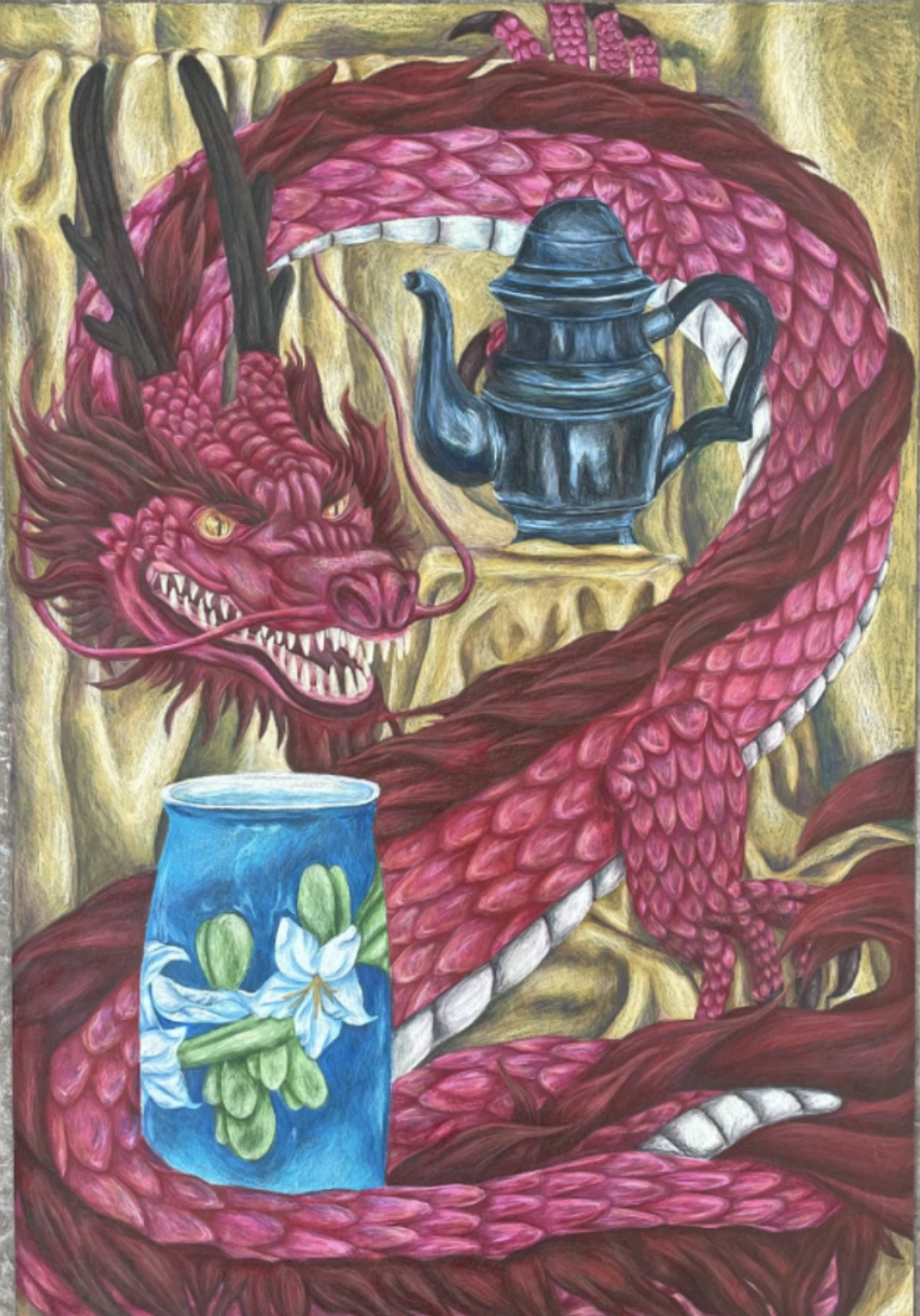
For my concentration, I chose to dive into the topic of traditional Chinese beliefs, primarily focusing on dragons because of their prominent feature in Chinese culture. Being brought up in a very traditional Chinese household has shaped my daily life tremendously; my mother would forbid me to wear certain colors that are deemed unlucky and fed me a lot of food that would bring prosperity in my life. Because I have been immersed in this culture for so long, I am particularly interested in this theme and wanted it to be the main focus of all my artworks in my portfolio. For all of my drawings and paintings, I took a lot of consideration into the colors I decided to use, usually choosing to use colors that are significant to Chinese culture, like the color red, symbolising good luck, joy, and happiness (similar to Madison’s). In my first piece, I used part of the still life that had different levels of boxes with a vase and kettle on two of the boxes. Then, I added a dragon that slithered around the objects and boxes like it was protecting the objects as if it was theirs. In Chinese culture, dragons symbolise strength and good luck as they also have great power. I purposely placed the dragon around the objects to showcase its authority and possessiveness over the objects, and I also colored the dragon’s scales to be a shade of red. Other pieces I did include a portrait drawing of a dragon's head coming off of a brick wall, similar to the one that may be found in the Forbidden City, and a drawing of koi fish swimming in a soup bowl.
Ingrid and Katie both increased the size of their canvases, doubling the usual size of the paper, so they took more time to complete their piece. Their pieces focused on their individual interests. Ingrid, a Classics student, had her piece encompass a myth: Acteon and the dogs. She incorporated different elements and designs into her drawing from the time period of the Greek myth. Katie, who took Advanced Studio last year, continued her theme of birds from her AP art portfolio. She examined the historical, cultural, and emotional responses birds convey to a diverse range of audiences. The piece she began in the ACA focuses on a multitude of birds, utilising varied and precise lines and bold color to reflect the liveliness of the different species.

Advanced Studio is a rigorous and fast-paced course, however, with all of our mutual passion for art, we have and will continue to produce a range of well-thought-out pieces that convey themes of our particular interest. We are all looking forward to the year ahead of us, especially working and finally completing our pieces for our portfolio.