
Prize Day Issue
May 15 2026
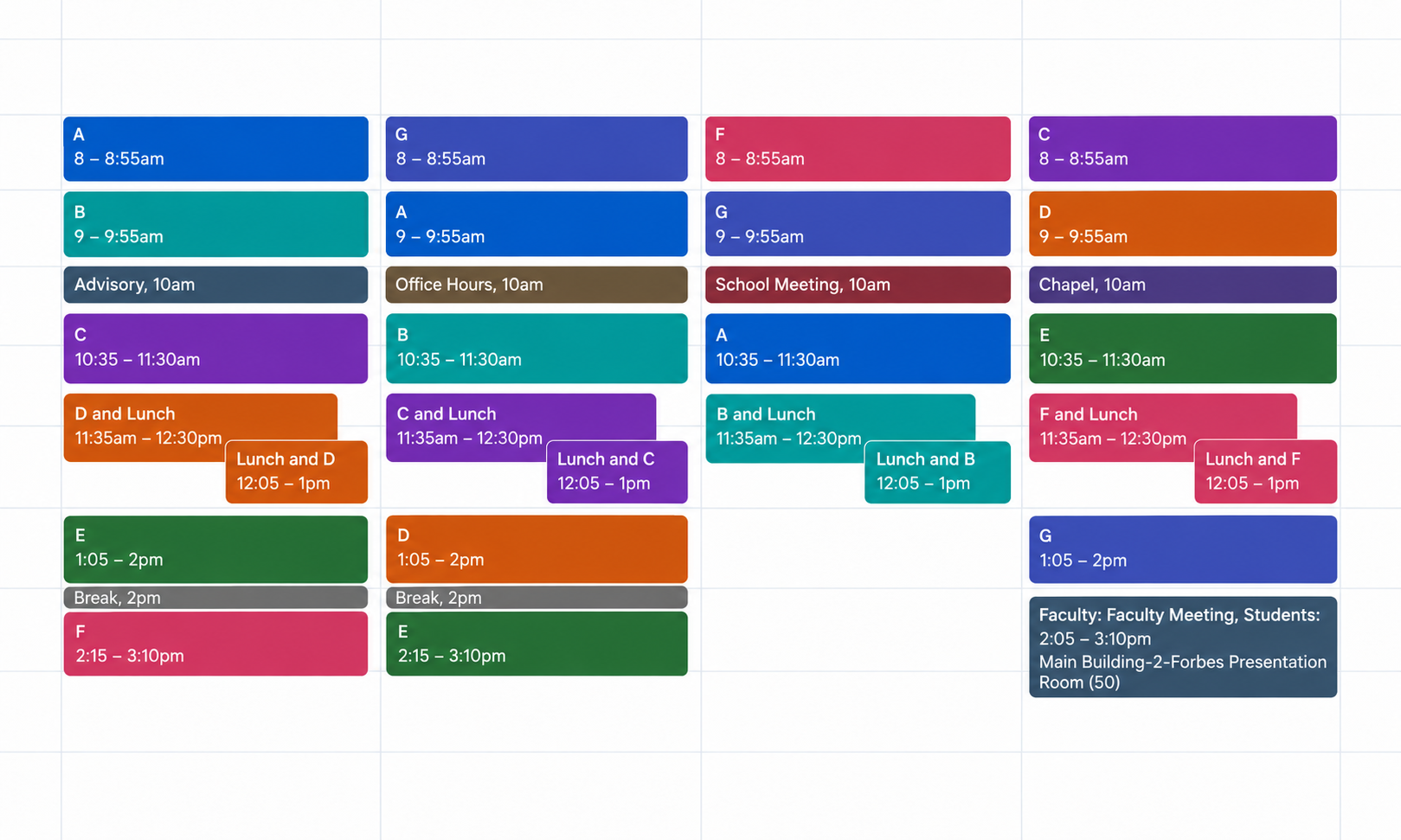
4 Day Week Schedule: Is Cramming 21 Classes in 4 Days the Best Way to Manage a Short Week

By Lauren Laskowsky ’29 and Jay O Park ’30
When the students of St. Mark's checked their calendars, many were shocked by the upcoming second week of school. In big and bold letters, a daunting 6-class Monday sat on their laptop screens, the beginning of a four-day week packed with 21 classes. This led students to wonder, “Why on Earth do we need to meet with our teachers 3 times in 4 days?”
September 7th, and the start of the second week of school, immediately plugged kids into the intensity of the shortened schedule. Six classes meant students had to move nonstop, and the additional homework was unending. Justin Yang, a 4th former, says, “I had almost four hours of homework every day.” For some, the schedule was so packed that there was barely enough time to eat lunch before moving on to the next commitment. The shortened lunch time, along with the incredibly long line to wait for your food, turned what normally would be one of the few breaks in the academic day into something students had to rush through.
The next day was like Monday all over again: six classes, back to back with what felt like no breathing room. The homework load showed no mercy, and neither did our sleep schedules. Ms. Plimpton, English department head and teacher, had shared some of her thoughts with us, and she said, “To launch the year with two back-to-back irregular weeks felt super disorienting. The four-day week drained me of all life force. I blame my cold on the whiplash!” She described the four-day week as draining and almost sucking the life out of her. We can attest that everyone else felt the same exact way, Ms. Plimpton.
By September 9th, it’s hump day. Everyone was trying to make it through the week on very little sleep, along with athletic games stacked on top of the heavy workload. A normal Wednesday schedule consists of three one-hour and five-minute classes; now it has four 55-minute classes. The four-day week schedule was like jumping on a treadmill moving 200 miles per hour, with no training at all. Your brain is moving faster than you physically can. Is meeting your teachers three separate times in four days really worth the sleepless nights and shoving two pieces of pizza in your mouth in under 5 minutes because you don’t have time to sit down? We think not.
On Thursday, it was the final stretch. The feeling that the hellish schedule is finally coming to an end. But no! A new activity has been implemented for Friday. Form day! When you finally think you’ll get some reprieve, you have to do form bonding with your grade for the entire next day. Come on, wouldn’t you be excited to make cardboard chariots with your classmates at 8 A.M. right after what it felt like being thrown in the wringer? It seemed to never end. Emily Tian ‘29 said, “I’m taking 7 classes this semester, and I can’t seem to take a break. I am going to sleep at the wee hours of the morning, and it’s only the second week of school.” She seemed like she’s going through it, and that was just a taste of it.
What does the Student Life Office have to say? The student body monitors are meeting with the Student Life Office on September 30th to explain themselves and what they can do. Will the monitors make a change? Will the students' voices be heard?

Phone Policy: Solution to Social Media Addiction or a Barrier in Student Life?
By Serena Lin ’28 and Nina Zhang ’29
A buzz of excitement, along with the never-ending chattering, ran down the hallways on the first day of the new school year; along with that, though, something was missing: the constant checking of phones. An email was sent out before the school year officially kicked off; an uproar of student dissatisfaction began, cell phones were no longer permitted on campus. Not for checking schedules, not for knowing the time, and not for looking out for emails.
You know that wide-eyed look you get when you’re new to a place and you can’t find anything? We usually see that look on new students trying to find their way around; however, this year, it appeared on every single person trying to find their friends after chapel or an all-school assembly. It was practically impossible, with every person in the school having a different place they needed to get to.
The first day was beyond chaotic, with lost students everywhere and people pulling out laptops in the middle of the hallways to check their schedules or where they were supposed to be headed. Yet, this phenomenon continued; students were often late to classes, without easy access to a clock or their schedules; we were like ships without rudders.
Student dissatisfaction grew. In past years, students were able to pull their phones out of their pockets and check special schedules. Under the restriction of the phone policy, students are not allowed to do this. Although there are reminders at events that tell students where to go, there has been inconvenience in passing them around. The phone policy also caused inconvenience in terms of academic learning. Previously, students were able to take photos of notes or do a quick revision on their phones before class. Now, this can only be done on laptops and iPads.
“I feel like the phone policy doesn’t change anything except that I cannot text my friends to find them,” said a student in response to the phone policy. The phone policy limits communication to in-person and excludes online texting.
Still, changes were noticed; people began to interact more with each other and talk to people they’ve never really acknowledged before. Voices began to increase in common spaces, and the laughter that accompanied Instagram reels no longer existed. In a world where digital communication and technology have already been engraved into our lives, this policy is forcing us to try something new. We, as a community, managed to engage much more during the academic day.
Though the phone policy appeared to be a pointless restriction to some students, it does prove to have a positive effect on other parts of the student community. In past years, when passing through the center, the hallway, and even the library, there were student yelling and laughing while scrolling through their TikTok. The digital connection cuts off in-person communication, as social media pulls away the attention of students. Pulling students away from the digital world forces students to focus on the real world, corresponding to the theme of this school year, “Listening to Learn, and Learning to Listen”. By extricating themselves from the digital world, students manage to focus and learn how to listen to others in the community.
Whether the phone policy is reasonable remains a live controversy in the student body. The pros and cons of this policy are both illustrative. Personally, the author thinks that the phone policy is effective in allowing students to focus more on the St. Mark’s community instead of being trapped in their own isolated digital world. However, at the end of only the second week since back-to-school, the long-term effects of the phone policy are still open to discussion. Will the phone policy make the community more interconnected? Or will it waste student vigor through its inconvenience? The outcomes are still unclear.