
Prize Day Issue
May 15 2026
6 Time Spaceman: Interview with a St. Mark’s Alumnus
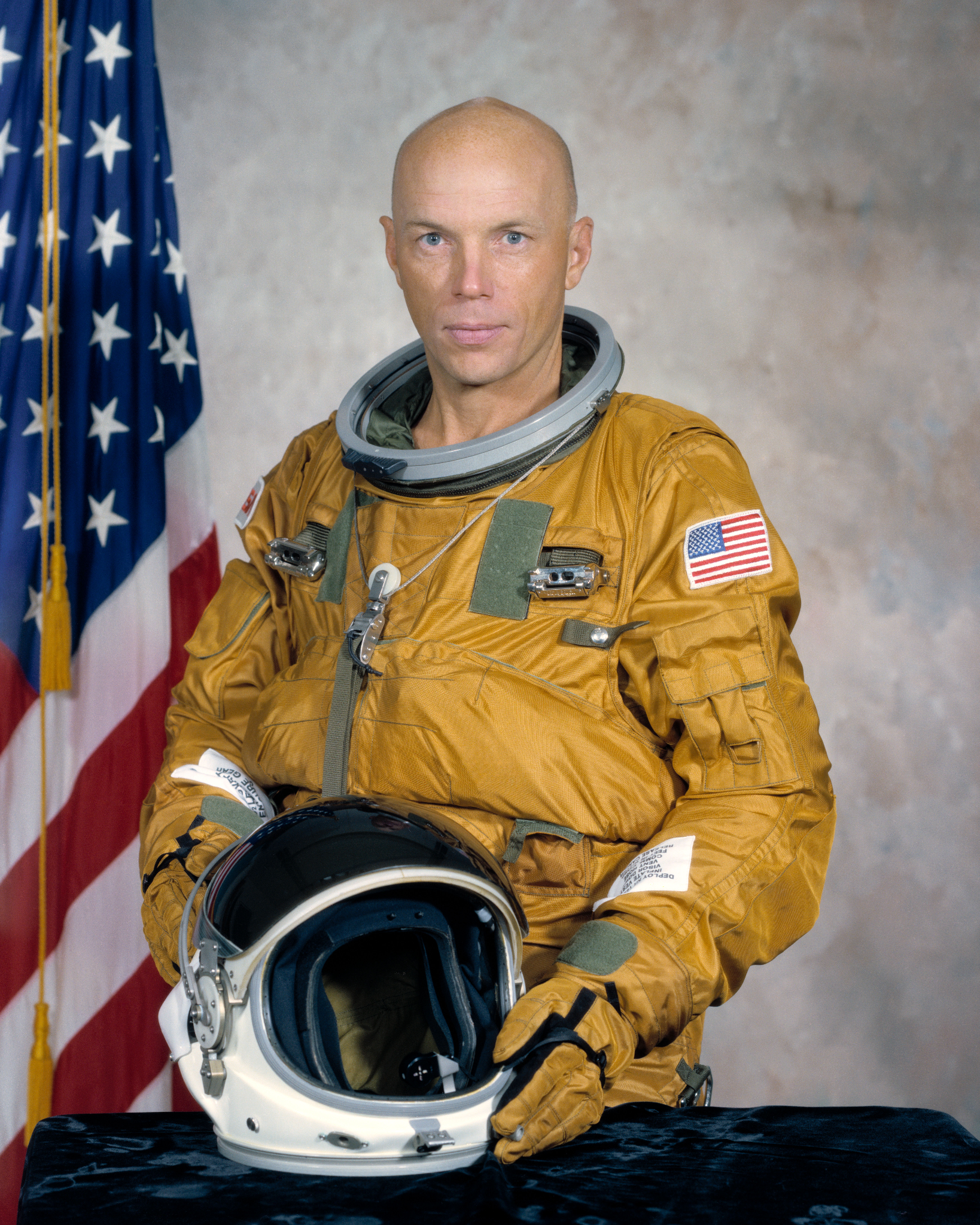
Picture Source: Wikipedia
By Serena Lin ’28
As of this year, St. Mark’s has a long and impressive history of 161 years. 161 years of history, 161 cohorts of students, and 161 graduating classes of alumni. In high school, not a lot of students have an idea of what career they want to pursue and where they will end up. The alumni community of St. Mark’s School encompasses a lot of different fields, including finance, mathematics, engineering, and more. This time, Dr. Story Musgrave agreed to share his valuable insights from his experience at St. Mark’s School.
Dr. Musgrave graduated from St. Mark’s in 1953 before diving into his impressive academic journey: 2 bachelor's degrees, 3 master's degrees, 1 doctoral degree, and more than 20 honorary doctorates. Throughout his impressive career as an astronaut, Dr. Musgrave has completed 6 space shuttle missions and has accumulated a total spaceflight time of over 1200 hours. His most celebrated flight, STS-61 in 1993, carried out the historic repair of the Hubble Space Telescope. Beyond his public achievements, Dr. Musgrave also revealed some fun facts about himself.
The first catchy thing about Dr. Musgrave is his unique first name. Dr. Musgrave bears a name that feels almost prophetic: his life unfolds as a story of remarkable accomplishments. Dr. Musgrave expressed his affection for the name and stated that it's a family lineage name. His daughter is named Story (little Story, as he calls her), and there is a running lineage of “Stories” throughout the history of the United States. Dr. Musgrave also thinks that Wikipedia did a good job of picturing him after reading through the website.
When asked about his career, Dr. Musgrave stated: “You're not just chosen because you're an expert in something. You're chosen to get that job done.” In his expert work as a space doctor, Dr. Musgrave talked about the difficulties of living in space. “70% of astronauts are sick in space, and 50% of them are vomiting.” With a crew of seven astronauts, some of them are able to do their work while they are sick, and some are not able to. “You’ve got to hang them on the wall and wait till they can function”.
“The toughest thing about space,” he added, “is the space motion sickness. We humans are designed to be a 1G environment creature; long-term 0G conditions in space can harm the health of an astronaut.” But instead of fearing the 0G condition, Dr. Musgrave loved the 0G condition. He was the only one who didn’t strap himself up when going to sleep, and he always found it interesting where he floated to when he woke up.
Talking about the start of his career as an astronaut, Dr. Musgrave agreed that his life as a farm kid surged his enthusiasm in the field. The crescent and the eclipses that he could not see in cities gave him a large advantage.
Dr. Musgrave also gave advice to the St. Mark’s Student community.
“If a student at St. Mark’s wants to become an explorer, someone who pushes the boundaries, what should they do?”
“Pursue the exploration; explore different avenues. Put yourself in different conditions. Always hold courage in what you are doing: I don't know much about what I'm doing, but here I am. “
In Dr. Musgrave’s high school days, he didn’t know where he was going to go either. He followed his heart, his passion. “That’s all that makes the difference,” he said, “It's essential that you are excited to pursue the path that you have chosen.” Even if we are still unclear about our interests, our passion, or the route that we want to devote our life to, it is important to follow what our heart tells us.
To conclude the interview, Dr. Musgrave reminds the students to be more mindful of what's around them. “Because when you look at the night sky, the crescent moon, the eclipses, what's gonna turn the heart on also turns the memory on.”
True to his name, Dr. Story Musgrave’s narrative remains far from finished. Before the conversation ended, Dr. Musgrave extended his greetings to Dr. Hills. The insights shared in this conversation form only one chapter of a lifelong story built on relentless exploration, both in the cosmos and within the realm of knowledge.
Walk to Listen: Andrew Forsthoefel’s Journey across America
Andrew Forsthoedo’s at St Mark’s
By Zihan (Chelsea) Cao ’28
“What would the world look like if everyone deeply knew each other?”
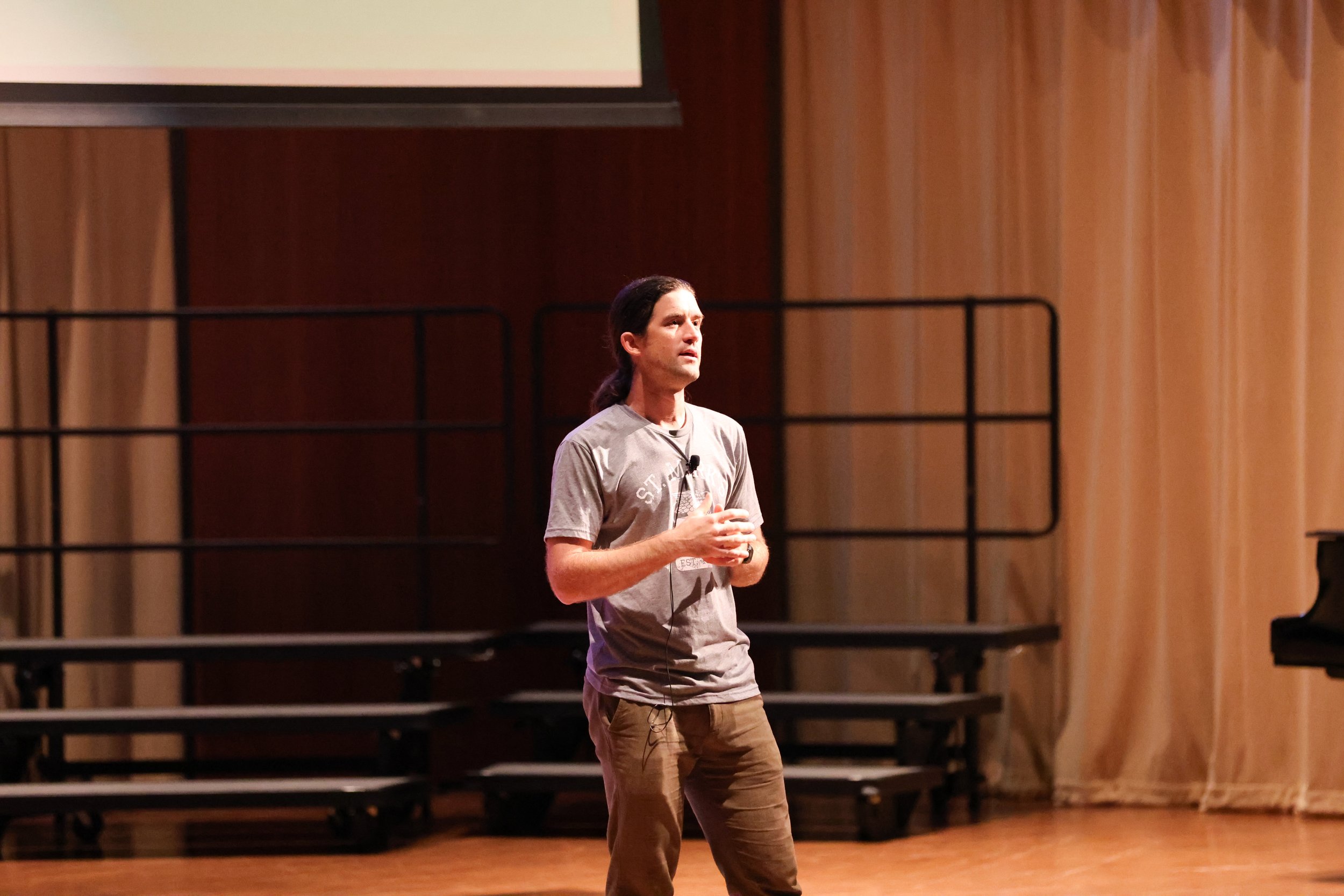
This was the question that persisted with Andrew Forsthoefel at the start of his adulthood. As the first Gray Colloquium speaker of the 2026-2027 year, Forsthoefel shared a story about how he traveled 4000 miles across America and how his view of listening changed throughout the journey. On that journey, he explored how fear became trust, how strangers became mentors, and how listening can transform how we understand each other.
The story starts with Andrew Forsthoefel attending St. Andrew’s School as a student. At that moment, his parents had just divorced. He could not bear the pain, so he escaped to boarding school. On his first night at St. Andrew’s School, this was the first time he experienced trust built on listening. The genuine environment invited Forsthoefel to tell his roommate about his parents’ divorce. Then, one of the boys, Tally, simply replied, “Me too.” This conversation was brief, but it meant a lot to Andrew Forsthoefel. The private pain suddenly became something that he and his roommate shared. This moment led Andrew Forsthoefel to a question: What percentage of ourselves do we actually reveal on the surface? People could spend years sitting with their classmates, teachers, or friends, but still know only a little about their peers.
The significance of listening deepened in Forsthoefel’s mind when he went to college. Following the traditional process of going to a good college and graduating, it seemed like he had achieved a significant milestone in his life. But he was still confused about the world around him. He did not know what adulthood meant. His education gave him knowledge, but he still felt like something was missing from his adulthood—listening (as he reflected after the journey).
Soon, this confusion turned into a walk across America.
The journey was painful at first, both physically and mentally. With training beforehand, Andrew Forsthoefel packed all he needed into a backpack and started walking. His mother took the photo on the day he left. She told him, “Lift your arm up.” Paradoxically, this pose of triumph made him “burst with tears”. Beneath this excitement, he finally realized that he was going to leave, and he did not know what would happen in his future. “What if [he] dies on the journey?” he asked.
Soon after, fear was the first emotion that accompanied his journey. When he met Bob, his mother’s landlord, Bob gave Forsthoefel a knife. This knife represents his instinctive fear of the unknown. At this point, he assumed that any strangers on his track might first be a danger.
However, this assumption about strangers changed as he walked. On the track, he met three young men. Forsthoefel thought these strangers might treat him as a weird person because he wore a cowboy hat, carried a huge backpack, and had two flags — an American and a world flag—on it. But these three strangers didn’t. After they all introduced themselves, these three strangers gave him apple juice and cookies because they thought Forsthoefel might need this. When the rain began pouring, they even invited Forsthoefel into their home.
Starting from this experience, Forsthoefel’s view started to change. One encounter with the indigenous tribe Laguna Pueblo in New Mexico truly changed his perspective. At that moment, Forsthoefel was frightened because of the violent history between the Indigenous people and white Americans. He said to his friend Tally, “Maybe I should just keep on the highway.” He didn’t know what would happen with these indigenous people. This fear accompanied him when a truck passed by and two Laguna men came down. Surprisingly, they did not react with any anger about the history; they offered Forsthoefel food from the ceremony. After that, these two men also invited Forsthoefel to their home. This encounter contradicted the story Forsthoefel imagined would happen. Instead of hostility, he experienced “generosity.” He suddenly realized how easily people could fill in the impression of one another, even though the other person did not have an opportunity to speak for himself yet. Listening was “vulnerable”, as Forsthoefel said, because it required us to delete all of the story that we already filled out for other people. But this deletion is the key to deep connection.
Forsthoefel’s final destination was the Pacific Ocean. After thousands of miles, conversations, and experiences, he walked into the water. But “this wasn’t the ending.” His life still continued, accompanied by all the lessons he learned from this journey. “Each moment,” as Forsthoefel suggested, was another “invitation.” Maybe that is why he felt so connected to the school community. He recalled another classroom moment of a girl whose story he believed he knew. But once the girl stood up and shared her story, Forsthoefel realized that he never truly knew this girl; he never truly saw this girl’s inner heart. She was “glow[ing],” as Forsthoefel described.
Schools, our neighbors, and our lives — all of these are filled with people that we are familiar with. We know their names, their classes, their teams, and their personalities. But Forsthoefel doubted, “Do we actually know their [true] stories?” He teaches us that listening is never a passive thing; it is a process of vulnerability under uncertainty. It requires deliberately deleting the story we constructed in our minds. The distance between two people may be far more than 4000 miles at first, but Forsthoefel offers a simple way to walk towards each other. We can start our own journey of listening, just like Forsthoefel’s trip across America, by simply asking a genuine compass question and listening to others' thoughts.