Prize Day Issue
May 15 2026
Exploring Sustainable Fashion in Antwerp: A Research Journey Funded by the A.A. Jones Grant
Isabelle Lee ‘27
One of the many incredible opportunities offered by St. Mark’s is the grant program. Through the support of the A.A. Jones International Studies Grant, I was fortunate to travel to Antwerp, Belgium, over the summer to study and explore sustainability in the fashion industry through a pre-planned tour. My goal was to investigate how environmental challenges are being tackled in the fashion industry and through what innovations sustainability is being promoted.
This grant allowed me not only to observe sustainable practices firsthand but also to engage directly with designers, retailers, and institutions dedicated to pioneering new approaches to production and consumption.
Why Antwerp?
Antwerp is widely regarded as a global fashion capital, known for producing visionary designers such as the Antwerp Six. While the city’s fashion history is rooted in creativity and avant-garde aesthetics, I also discovered it is a hub for designers deeply intertwined in sustainability. Antwerp does not treat sustainability as a marketing trend, but rather as a responsibility.
My research began at the MOMU Fashion Museum, where exhibitions reveal the history of Antwerp. From the reconstructed Maison Margiela workspace, characterized by its complete monochromatic aesthetic, to exploring the permanent exhibition on the Antwerp Six, a group of designers who put Antwerp as a major player in the fashion scene, I was able to learn about the story of Antwerp's sudden rise to fashion prominence.
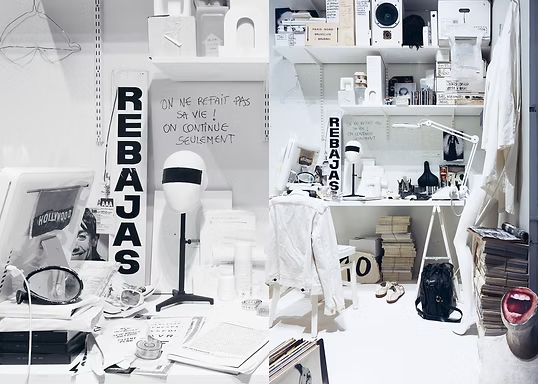
Maison Margiela Workspace
Investigating Sustainable Design Practices
With guidance from COSH!, a platform for ethical fashion, I explored boutiques and studios across the city. At the atelier of designer Abelone Wilhelmsen, I observed garments made from locally sourced fibers and dyed using pigments derived from fungi. These natural dyes are biodegradable and environmentally safe, providing an alternative to synthetic dyes that pollute waterways. Wilhelmsen explained that the fading of natural dye over time is not considered a flaw but instead a part of a garment’s story.
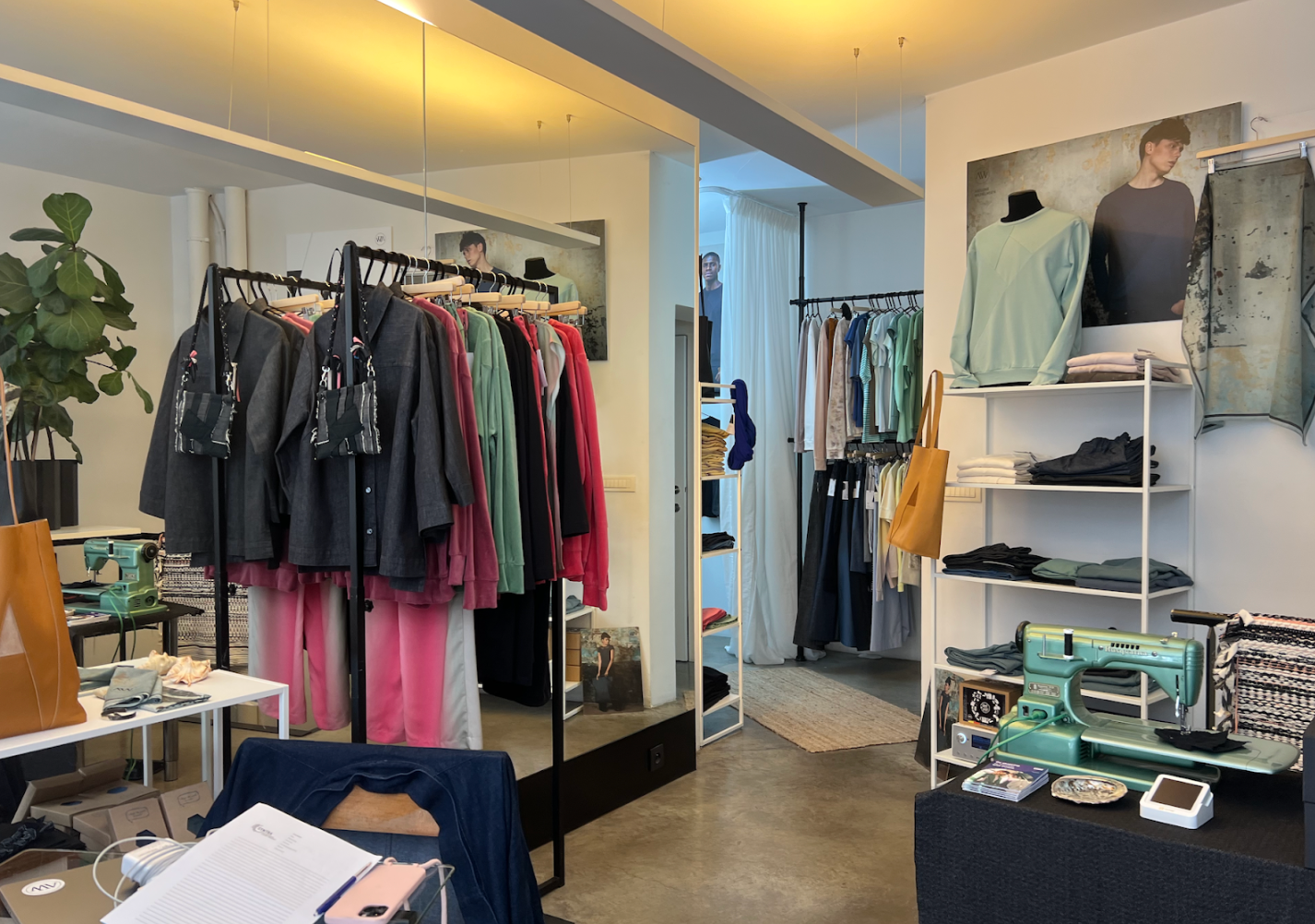
Abalone’s Atelier
This visit highlighted a central principle of sustainability in Antwerp: clothing is designed to evolve with its wearer, not to be discarded after a single season.
Circular Fashion in Action
Another key component of my research was studying circular fashion. In Antwerp, I found thrift shops where garments were sold by weight, rental services such as Dressr featuring only local designers, and upcycling centers transforming craft supply waste into new products. At REST, an upcycling studio, I learned that even seemingly unusable materials, such as dried-out markers and leftover yarn, are repurposed into spray paint and accessories. The owner’s philosophy resonated deeply with redefining my definition of sustainability: “Every object already has an environmental impact. Sustainability means extending its life, not replacing it.”
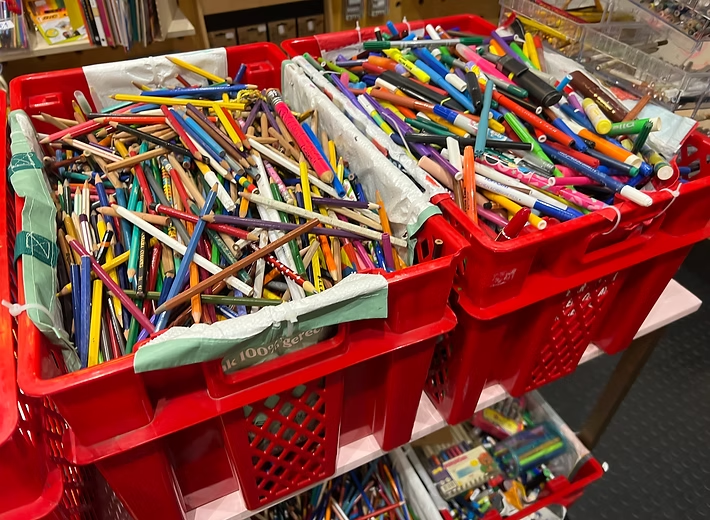
Collection of used pencils for sale at REST
Through these experiences, I was able to see how sustainability is embedded not just in designer studios, but in the everyday shopping habits of the city’s residents.
Challenging Assumptions About Sustainable Materials
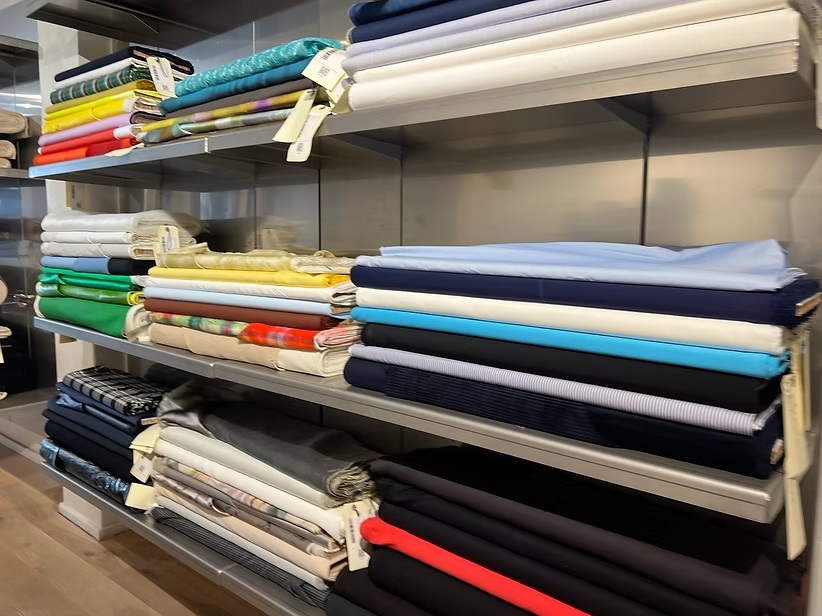
One of the most significant insights from my research came during my visit to Bakermat, a textile library for designers. There, I was encouraged to question commonly accepted ideas about sustainable materials. For example, although recycled or exotic fabrics are often marketed as eco-friendly, their environmental impact depends on transportation, water use, and end-of-life disposal. A fabric made from seaweed or Japanese denim may sound sustainable, but if it must be shipped across oceans, its carbon footprint may outweigh its benefits.
Collection of used pencils for sale at REST
This experience shifted my understanding of sustainability, challenging my previous beliefs about it. Having originally entered this grant centered around the idea of exploring just innovative textiles, this visit encouraged me to focus less on the fiber name, but instead on the whole journey of the textile.
Impact of Grant
The A.A. Jones Grant enabled me to engage in a level of inquiry that would not have been possible through classroom research alone. By observing sustainability as it functions in real environments and speaking with the individuals immersed in the industry, I gained a deeper, more nuanced understanding of fashion’s environmental challenges and potential solutions.
My findings reinforced the idea that sustainability is not a single solution, but a commitment to valuing materials, honoring craftsmanship, and designing with longevity in mind.
Conclusion and Future Impact
Through the research I conducted, I now possess a redefined understanding of sustainability, focusing on a holistic evaluation of a garment's life cycle. Sustainability is not just a label determined by fabric choice or brand name; instead, it is about having transparency in the manufacturing process and understanding both the social and environmental impacts.
With the knowledge gained from this research experience, I want to apply my new definition of sustainability to create garments designed to last, pieces that tell stories of craftsmanship, cultural connection, and environmental respect. By manufacturing clothing close to home and working directly with local artisans and textile producers, I aspire to reduce carbon emissions, support local economies, and ensure complete transparency in every stage of the production process.
Lastly, I want to call students and faculty at St. Mark’s to make a change, no matter how big or small, to try and be more sustainable.
If you want to learn more about my grant, feel free to contact me through Gmail or check out my blog.
St. Mark’s Welcomes New Penn Fellows
Manasa Mahesh ‘27
This fall, St. Mark's has welcomed two new Penn Fellows to the Community. Olivia Szachta and Lachen Reid join us through the Penn Fellowship Program, a two-year program that is offered by the University of Pennsylvania’s Graduate School of Education. The program allows aspiring teachers to earn a master’s degree in education while working as a fellow at a partner school.
Ms. Szachta is joining us from Duxbury, Massachusetts, in the Math Department, and Mr. Reid is joining us from Minneapolis, Minnesota, in the Religion Department. Ms. Szachta is currently teaching Algebra II, and Mr. Reid is teaching two religion courses: JCI and Ethics & Mortality. Fun Fact: Ms. Szachta has a twin sister, and Mr. Reid has two dogs!
When asked what led them to work at St. Marks, Ms. Szachta explained how she decided she wanted to be a part of the St. Marks community first, which led her to decide to join the community as a Penn Fellow! Mr. Reid sought the opportunity to complete a master's degree while teaching in the religion department, which led him to become a Penn Fellow.
Ms. Szachta said her experience has been very good so far, and she is enjoying taking part in all the different community aspects of St. Mark's. Coaching on JV Volleyball and being on duty in Thayer have been great experiences to connect with students more. She said that she went to public school, so being able to connect with students on a deeper level has been a highlight!
They both enjoy FLIK Dining, as it reminds them of their college dining halls, and having many options is great. Mr. Reid especially enjoys all the options at lunch, like the stir-fry section and the panini machine.
Both of them have experiences they want to bring to the St. Mark's community. Ms. Szachta talked about her experience on the crew team in college, and she is excited to bring that experience to the Girls Crew team this spring. She also has a background in psychology and wants to share her knowledge on the topic to St. Mark's students. Mr. Reid wants to work with students on their writing, as he worked at a writing center in college. His goal is to help students learn to love writing and not view it as a chore.
Looking forward to the rest of their time at St. Mark's, Ms. Szachta is excited to explore other math than Algebra 2 and teach different classes. She is also excited about the coaching crew in the spring. Mr. Reid is excited for Groton Day games, as he coaches the Thirds Boys' Soccer team.
Both offered advice: Ms. Szachta said she would tell St. Markers that learning is more important than the answer and to focus more on the process, not just the outcome. Mr. Reid said that students should take advantage of the small community and spend as much time with friends as possible.
Make sure to welcome the Penn Fellows!